



Ich stimme der Verwendung von Cookies zu. Auch wenn ich diese Website weiter nutze, gilt dies als Zustimmung.

Bitte lesen und akzeptieren Sie die Datenschutzinformation und Cookie-Informationen, damit Sie unser Angebot weiter nutzen können. Natürlich können Sie diese Einwilligung jederzeit widerrufen.


The dilemma of the ECB continues (Martin Ertl)

4 weitere Bilder
(mit historischen Bildtexten)

Interest rates on bank loans

Credit Growth (%, y/y)

Credit standards (net %-age change)

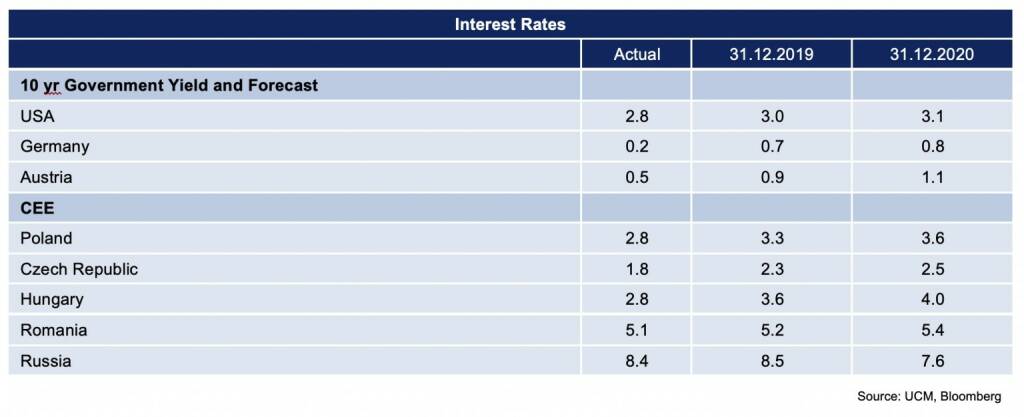
Interest Rates


Autor:
Martin Ertl

Chief Economist, UNIQA Capital Markets GmbH

>> Website


>> zur Startseite mit allen Blogs

29.01.2019, 7649 Zeichen
  • Leading survey-based indicators send warning signal for Euro Area business cycle. 
  • ECB leaves monetary policy stance unchanged. Risk for growth are tilted to the downside.
  • Additional long-term refinancing operations (LTRO, TLTRO) would be a signal though imperfect tools to address a growth slowdown.

  In January, the composite purchase manager index (PMI), a major survey-based business cycle indicator, dropped to a new low (50.7 after 51.1). The index remained above the expansion threshold (50) and keeps indicating weak growth in economic activities in the Euro Area. The manufacturing and services sector components fell to 50.5 (after 51.4) respectively 50.8 (after 51.2). The German manufacturing PMI index tipped below the expansion threshold (49.9) for the first time since 2014 (Figure 1). 

In France, while the manufacturing PMI rebounded gradually (to 51.2 from 49.7), the services index came out particularly weak (47.5 after 49). This could be related to the political “gilets jaunes” protests. The Italian manufacturing PMI rose gradually (49.2) but has been in contraction territory since October. At the same time, the ifo-business climate, the most prominent business survey for the German economy, dropped sharply to the lowest level since 2016 (99.1) indicating a growth slowdown in Germany. 

Purchase manager indexes are highly correlated with GDP growth. A simple linear regression implies 0.2 % quarterly GDP growth based on the January PMI outcome. In line with that, our own nowcasting model for the Euro Area is indicating 0.2 % (q/q) GDP growth for Q4 of last year and a one period ahead forecast is at 0.3 % (q/q) for Q1 2019. Both indicate that no growth rebound occurs after the weak GDP growth (0.2 % q/q) in Q3 2018 and contradict the ECB staff GDP projection from December. The ECB forecast 1.7 % GDP growth for 2019, which implies a pick-up in quarterly GDP growth. Hence, risks for this forecast are tilted to the downside. The ECB staff will likely have to revise downward its 2019 GDP growth projection in March. 

At last week’s meeting, the governing council (GC) of the ECB left the interest rates on the main refinancing rate, the marginal lending rate and the deposit facility unchanged at 0.0 %, 0.25 % and -0.40 %. Also, the ECB’s forward-looking communication (“forward guidance”) was left unchanged as it expects the key interest rates to remain at their present levels at least through the summer of 2019, and in any case for as long as necessary to ensure the sustained convergence of the inflation rate to the inflation target. In addition, the GC intends to continue reinvesting, in full, the principal payments from maturing securities purchased under the asset purchase programme for an extended period of time past the date when it starts raising the key interest rates. We reckon that this would be around two years. 

President Draghi highlighted that incoming information about the Euro Area economy has continued to be weaker than expected on account of softer external demand and some country and sector-specific factors. The near-term growth momentum is likely weaker than anticipated previously. In difference to the December statement, risks to the growth outlook have now moved to the downside. 

Based on current futures prices for oil, headline inflation is likely to decline further over the coming months. On the other side, labor cost measures are continuing to strengthen. (We had discussed both effects in our publication last week. [1]) 

For the scenario that a growth rebound will fail to occur, additional measures to loosen monetary policy are discussed, including long-term refinancing operations (LTROs) and targeted long-term refinancing operations   (TLTROs). These measures were introduced to restore the transmission of monetary policy through the credit channel. Essentially, this means that lower policy interest rates should translate into lower bank lending rates. They address a credit crunch. TLTROs provide long-term funding at attractive conditions to banks to stimulate bank lending to the real economy. The 1st series of TLTROs was announced in June 2014 and the 2nd series (TLTRO II) in March 2016. The amount of these operations – the amount that banks can borrow – is linked to the loans to non-financial corporations and households. The TLTRO II linked the interest rate to be applied to the participating banks’ lending patterns. The more loans a participating bank issues to non-financial firms and households, the more attractive the interest rate on their TLTRO II borrowings became. These operations had four-year terms and a current outstanding amount of 740 bn EUR.  Early repayment of the TLTROs is possible since June 2018 and the first TLTRO has its final maturity in June 2020. 

    Figure 2 shows interest rates on bank loans for non-financial corporates (over 1 & up to 5 years maturity), which have declined considerably in peripheral countries since the Euro crisis 2011/12. In 2014, bank loan interest rates were 3.6 %, 4.3 % and 5.1 % in Spain, Italy and Portugal. They decreased substantially to average 1.8 % (ES), 1.7 % (IT) and 2.2 % (PT) in 2018.  

At the same time, credit lending to non-financial corporates and households has been recovering (Figure 3). In 2014, the total amount of loans to non-financial corporations had fallen to 4.3 trillion EUR from 4.7 trillion EUR in 2011. Since then, the amount has been rising to 4.4 trillion EUR in 2018. In November, bank lending to non-financial firms rose by 2.9 % annually. The total outstanding amount of loans to households rose from 5.2 trillion EUR in 2014 to 5.7 trillion EUR in 2018. Consumer loans and loans for house purchases increased by 6.7 % and 3.3 % (y/y) in November 2018.  

According to the January 2019 bank lending survey, credit standards remained broadly unchanged for loans to enterprises and housing loans compared to the previous quarter (Figure 4, minus = easing, positive = tightening). Given the extended period over which credit standards have been easing, bank lending conditions continue to support loan growth. In addition, loan demand continued to increase across all loan categories, according to the survey. 

Lower interest rates on bank loans, the recovery in credit supply and easier bank lending standards are evidence that a continued credit crunch could be avoided since 2014 and the transmission of monetary policy to the real economy through the lending channel was restored. The Euro Area banking sector is not in the situation that prevailed until 2014. 

The ECB would not tighten monetary policy into a slowing economy. We believe that, first, we would have to see a growth rebound in the coming months and, second, a sustained medium-term convergence of inflation – driven by a continuous rise in labor cost – towards the ECB’s inflation target, before the central bank would start to increase its main policy interest rates. 

Long-term refinancing operations, in particular TLTROs, likely helped to restore the credit channel but would not be the most adequate monetary policy instrument to target a growth slowdown; except for its signaling function. Nevertheless, the ECB has continuously been issuing LTROs with a 3-month maturity and could lengthen the tenor of these operations, in case outstanding operations (TLTROs) will be repaid early in the coming months. 

[1]UNIQA Capital Markets Weekly as of January 21st: Decoding Euro Area’s inflation: on oil prices, labor costs & profit shares; http://press-uniqagroup.com/News_Detail.aspx?id=78418&menueid=1684

Authors

Martin Ertl Franz Xaver Zobl

Chief Economist Economist

UNIQA Capital Markets GmbH UNIQA Capital Markets GmbH


(29.01.2019)

BSN Podcasts
Christian Drastil: Wiener Börse Plausch

kapitalmarkt-stimme.at daily voice: Wie es über den Jahreswechsel mit unseren Podcasts weitergeht ...


Bildnachweis

1. Manufacturing PMI

2. Interest rates on bank loans

3. Credit Growth (%, y/y)

4. Credit standards (net %-age change)

5. Interest Rates

Aktien auf dem Radar:VIG, Amag, FACC, Pierer Mobility, EuroTeleSites AG, Addiko Bank, Frequentis, Rosgix, DO&CO, Frauenthal, Hutter & Schrantz Stahlbau, Hutter & Schrantz, Stadlauer Malzfabrik AG, Wolford, Oberbank AG Stamm, EVN, Flughafen Wien, CPI Europe AG, Kapsch TrafficCom, Österreichische Post, Semperit, Strabag.


Random Partner

BNP Paribas
BNP Paribas ist eine führende europäische Bank mit internationaler Reichweite. Sie ist mit mehr als 190.000 Mitarbeitern in 74 Ländern vertreten, davon über 146.000 in Europa. BNP Paribas ist in vielen Bereichen Marktführer oder besetzt Schlüsselpositionen am Markt und gehört weltweit zu den kapitalstärksten Banken.

>> Besuchen Sie 62 weitere Partner auf boerse-social.com/partner


Interest rates on bank loans


Credit Growth (%, y/y)


Credit standards (net %-age change)


Interest Rates


 Latest Blogs

» Börsegeschichte 15.12.: RHI Magnesita (Börse Geschichte) (BörseGeschichte)

» Nachlese: Roland Meier, shadowmap.org, VIG vs. Uniqa, Norbert Peter vs. ...

» PIR-News: Research zu VIG, RBI, Polytec, News zu Post, BKS, Flughafen Wi...

» Wiener Börse Party #1055: ATX weiter stark, VIG mit heute 2025er-Verdopp...

» Wiener Börse zu Mittag fester: Frequentis, VIG und Wienerberger gesucht

» Börsepeople im Podcast S22/13: Roland Meier

» Börse-Inputs auf Spotify zu u.a. VIG vs. Uniqa, ÖTV Lilli Tagger, Societ...

» Österreich-Depots: Weekend Bilanz (Depot Kommentar)

» Börsegeschichte 12.12.: KTM, Immoeast, Robert Kastil, Michael Pistauer, ...

» Nachlese: Birgit Puck, Richard Dobetsberger, Martina Geisler, Karin Pühr...


Useletter

Die Useletter "Morning Xpresso" und "Evening Xtrakt" heben sich deutlich von den gängigen Newslettern ab. Beispiele ansehen bzw. kostenfrei anmelden. Wichtige Börse-Infos garantiert.

Newsletter abonnieren

Runplugged

Infos über neue Financial Literacy Audio Files für die Runplugged App
(kostenfrei downloaden über http://runplugged.com/spreadit)

per Newsletter erhalten


Meistgelesen
>> mehr


PIR-Zeichnungsprodukte
Newsflow
>> mehr

Börse Social Club Board
>> mehr
    wikifolio-Trades Austro-Aktien 22-23: Strabag(1), RBI(1), Uniqa(1)
    BSN MA-Event UBM
    wikifolio-Trades Austro-Aktien 20-21: Strabag(2), Uniqa(1), VIG(1)
    wikifolio-Trades Austro-Aktien 19-20: FACC(2), CPI Europe AG(1), Porr(1)
    wikifolio-Trades Austro-Aktien 18-19: Wienerberger(1), Kontron(1), Porr(1)
    Star der Stunde: Flughafen Wien 2.25%, Rutsch der Stunde: Austriacard Holdings AG -0.98%
    wikifolio-Trades Austro-Aktien 17-18: Bawag(2), Erste Group(2), Wienerberger(1), CPI Europe AG(1), VIG(1)
    BSN Vola-Event VIG
    Star der Stunde: Austriacard Holdings AG 1.71%, Rutsch der Stunde: Frequentis -3.02%

    Featured Partner Video

    Private Investor Relations Podcast #12: Ina Sabitzer moderiert die CIRA-Jahreskonferenz 2026 zum 10. Mal, im Podcast gibts Key Take aways

    Ina Sabitzer ist Moderatorin, Corporate Profilerin, Ex-Kommunikationschefin der Österreichischen Post und hat auch für die Deutsche Telekom kommuniziert. 2026 moderiert sie die CIRA-Jahreskonferenz...

    Books josefchladek.com

    Nikola Mihov
    The Last Gift
    2025
    Self published

    Adriano Zanni
    Sequenze di Fabbrica
    2025
    Boring Machines

    Wassili und Hans Luckhardt
    Zur neuen Wohnform
    1930
    Bauwelt-Verlag

    Ció Prat i Bofill
    Milions d’estels i un somni
    2025
    Self published

    Florian Rainer
    Tagada
    2025
    Fotohof


    29.01.2019, 7649 Zeichen
    • Leading survey-based indicators send warning signal for Euro Area business cycle. 
    • ECB leaves monetary policy stance unchanged. Risk for growth are tilted to the downside.
    • Additional long-term refinancing operations (LTRO, TLTRO) would be a signal though imperfect tools to address a growth slowdown.

      In January, the composite purchase manager index (PMI), a major survey-based business cycle indicator, dropped to a new low (50.7 after 51.1). The index remained above the expansion threshold (50) and keeps indicating weak growth in economic activities in the Euro Area. The manufacturing and services sector components fell to 50.5 (after 51.4) respectively 50.8 (after 51.2). The German manufacturing PMI index tipped below the expansion threshold (49.9) for the first time since 2014 (Figure 1). 

    In France, while the manufacturing PMI rebounded gradually (to 51.2 from 49.7), the services index came out particularly weak (47.5 after 49). This could be related to the political “gilets jaunes” protests. The Italian manufacturing PMI rose gradually (49.2) but has been in contraction territory since October. At the same time, the ifo-business climate, the most prominent business survey for the German economy, dropped sharply to the lowest level since 2016 (99.1) indicating a growth slowdown in Germany. 

    Purchase manager indexes are highly correlated with GDP growth. A simple linear regression implies 0.2 % quarterly GDP growth based on the January PMI outcome. In line with that, our own nowcasting model for the Euro Area is indicating 0.2 % (q/q) GDP growth for Q4 of last year and a one period ahead forecast is at 0.3 % (q/q) for Q1 2019. Both indicate that no growth rebound occurs after the weak GDP growth (0.2 % q/q) in Q3 2018 and contradict the ECB staff GDP projection from December. The ECB forecast 1.7 % GDP growth for 2019, which implies a pick-up in quarterly GDP growth. Hence, risks for this forecast are tilted to the downside. The ECB staff will likely have to revise downward its 2019 GDP growth projection in March. 

    At last week’s meeting, the governing council (GC) of the ECB left the interest rates on the main refinancing rate, the marginal lending rate and the deposit facility unchanged at 0.0 %, 0.25 % and -0.40 %. Also, the ECB’s forward-looking communication (“forward guidance”) was left unchanged as it expects the key interest rates to remain at their present levels at least through the summer of 2019, and in any case for as long as necessary to ensure the sustained convergence of the inflation rate to the inflation target. In addition, the GC intends to continue reinvesting, in full, the principal payments from maturing securities purchased under the asset purchase programme for an extended period of time past the date when it starts raising the key interest rates. We reckon that this would be around two years. 

    President Draghi highlighted that incoming information about the Euro Area economy has continued to be weaker than expected on account of softer external demand and some country and sector-specific factors. The near-term growth momentum is likely weaker than anticipated previously. In difference to the December statement, risks to the growth outlook have now moved to the downside. 

    Based on current futures prices for oil, headline inflation is likely to decline further over the coming months. On the other side, labor cost measures are continuing to strengthen. (We had discussed both effects in our publication last week. [1]) 

    For the scenario that a growth rebound will fail to occur, additional measures to loosen monetary policy are discussed, including long-term refinancing operations (LTROs) and targeted long-term refinancing operations   (TLTROs). These measures were introduced to restore the transmission of monetary policy through the credit channel. Essentially, this means that lower policy interest rates should translate into lower bank lending rates. They address a credit crunch. TLTROs provide long-term funding at attractive conditions to banks to stimulate bank lending to the real economy. The 1st series of TLTROs was announced in June 2014 and the 2nd series (TLTRO II) in March 2016. The amount of these operations – the amount that banks can borrow – is linked to the loans to non-financial corporations and households. The TLTRO II linked the interest rate to be applied to the participating banks’ lending patterns. The more loans a participating bank issues to non-financial firms and households, the more attractive the interest rate on their TLTRO II borrowings became. These operations had four-year terms and a current outstanding amount of 740 bn EUR.  Early repayment of the TLTROs is possible since June 2018 and the first TLTRO has its final maturity in June 2020. 

        Figure 2 shows interest rates on bank loans for non-financial corporates (over 1 & up to 5 years maturity), which have declined considerably in peripheral countries since the Euro crisis 2011/12. In 2014, bank loan interest rates were 3.6 %, 4.3 % and 5.1 % in Spain, Italy and Portugal. They decreased substantially to average 1.8 % (ES), 1.7 % (IT) and 2.2 % (PT) in 2018.  

    At the same time, credit lending to non-financial corporates and households has been recovering (Figure 3). In 2014, the total amount of loans to non-financial corporations had fallen to 4.3 trillion EUR from 4.7 trillion EUR in 2011. Since then, the amount has been rising to 4.4 trillion EUR in 2018. In November, bank lending to non-financial firms rose by 2.9 % annually. The total outstanding amount of loans to households rose from 5.2 trillion EUR in 2014 to 5.7 trillion EUR in 2018. Consumer loans and loans for house purchases increased by 6.7 % and 3.3 % (y/y) in November 2018.  

    According to the January 2019 bank lending survey, credit standards remained broadly unchanged for loans to enterprises and housing loans compared to the previous quarter (Figure 4, minus = easing, positive = tightening). Given the extended period over which credit standards have been easing, bank lending conditions continue to support loan growth. In addition, loan demand continued to increase across all loan categories, according to the survey. 

    Lower interest rates on bank loans, the recovery in credit supply and easier bank lending standards are evidence that a continued credit crunch could be avoided since 2014 and the transmission of monetary policy to the real economy through the lending channel was restored. The Euro Area banking sector is not in the situation that prevailed until 2014. 

    The ECB would not tighten monetary policy into a slowing economy. We believe that, first, we would have to see a growth rebound in the coming months and, second, a sustained medium-term convergence of inflation – driven by a continuous rise in labor cost – towards the ECB’s inflation target, before the central bank would start to increase its main policy interest rates. 

    Long-term refinancing operations, in particular TLTROs, likely helped to restore the credit channel but would not be the most adequate monetary policy instrument to target a growth slowdown; except for its signaling function. Nevertheless, the ECB has continuously been issuing LTROs with a 3-month maturity and could lengthen the tenor of these operations, in case outstanding operations (TLTROs) will be repaid early in the coming months. 

    [1]UNIQA Capital Markets Weekly as of January 21st: Decoding Euro Area’s inflation: on oil prices, labor costs & profit shares; http://press-uniqagroup.com/News_Detail.aspx?id=78418&menueid=1684

    Authors

    Martin Ertl Franz Xaver Zobl

    Chief Economist Economist

    UNIQA Capital Markets GmbH UNIQA Capital Markets GmbH


    (29.01.2019)

    BSN Podcasts
    Christian Drastil: Wiener Börse Plausch

    kapitalmarkt-stimme.at daily voice: Wie es über den Jahreswechsel mit unseren Podcasts weitergeht ...


    Bildnachweis

    1. Manufacturing PMI

    2. Interest rates on bank loans

    3. Credit Growth (%, y/y)

    4. Credit standards (net %-age change)

    5. Interest Rates

    Aktien auf dem Radar:VIG, Amag, FACC, Pierer Mobility, EuroTeleSites AG, Addiko Bank, Frequentis, Rosgix, DO&CO, Frauenthal, Hutter & Schrantz Stahlbau, Hutter & Schrantz, Stadlauer Malzfabrik AG, Wolford, Oberbank AG Stamm, EVN, Flughafen Wien, CPI Europe AG, Kapsch TrafficCom, Österreichische Post, Semperit, Strabag.


    Random Partner

    BNP Paribas
    BNP Paribas ist eine führende europäische Bank mit internationaler Reichweite. Sie ist mit mehr als 190.000 Mitarbeitern in 74 Ländern vertreten, davon über 146.000 in Europa. BNP Paribas ist in vielen Bereichen Marktführer oder besetzt Schlüsselpositionen am Markt und gehört weltweit zu den kapitalstärksten Banken.

    >> Besuchen Sie 62 weitere Partner auf boerse-social.com/partner


    Interest rates on bank loans


    Credit Growth (%, y/y)


    Credit standards (net %-age change)


    Interest Rates


     Latest Blogs

    » Börsegeschichte 15.12.: RHI Magnesita (Börse Geschichte) (BörseGeschichte)

    » Nachlese: Roland Meier, shadowmap.org, VIG vs. Uniqa, Norbert Peter vs. ...

    » PIR-News: Research zu VIG, RBI, Polytec, News zu Post, BKS, Flughafen Wi...

    » Wiener Börse Party #1055: ATX weiter stark, VIG mit heute 2025er-Verdopp...

    » Wiener Börse zu Mittag fester: Frequentis, VIG und Wienerberger gesucht

    » Börsepeople im Podcast S22/13: Roland Meier

    » Börse-Inputs auf Spotify zu u.a. VIG vs. Uniqa, ÖTV Lilli Tagger, Societ...

    » Österreich-Depots: Weekend Bilanz (Depot Kommentar)

    » Börsegeschichte 12.12.: KTM, Immoeast, Robert Kastil, Michael Pistauer, ...

    » Nachlese: Birgit Puck, Richard Dobetsberger, Martina Geisler, Karin Pühr...


    Useletter

    Die Useletter "Morning Xpresso" und "Evening Xtrakt" heben sich deutlich von den gängigen Newslettern ab. Beispiele ansehen bzw. kostenfrei anmelden. Wichtige Börse-Infos garantiert.

    Newsletter abonnieren

    Runplugged

    Infos über neue Financial Literacy Audio Files für die Runplugged App
    (kostenfrei downloaden über http://runplugged.com/spreadit)

    per Newsletter erhalten


    Meistgelesen
    >> mehr


    PIR-Zeichnungsprodukte
    Newsflow
    >> mehr

    Börse Social Club Board
    >> mehr
      wikifolio-Trades Austro-Aktien 22-23: Strabag(1), RBI(1), Uniqa(1)
      BSN MA-Event UBM
      wikifolio-Trades Austro-Aktien 20-21: Strabag(2), Uniqa(1), VIG(1)
      wikifolio-Trades Austro-Aktien 19-20: FACC(2), CPI Europe AG(1), Porr(1)
      wikifolio-Trades Austro-Aktien 18-19: Wienerberger(1), Kontron(1), Porr(1)
      Star der Stunde: Flughafen Wien 2.25%, Rutsch der Stunde: Austriacard Holdings AG -0.98%
      wikifolio-Trades Austro-Aktien 17-18: Bawag(2), Erste Group(2), Wienerberger(1), CPI Europe AG(1), VIG(1)
      BSN Vola-Event VIG
      Star der Stunde: Austriacard Holdings AG 1.71%, Rutsch der Stunde: Frequentis -3.02%

      Featured Partner Video

      Private Investor Relations Podcast #12: Ina Sabitzer moderiert die CIRA-Jahreskonferenz 2026 zum 10. Mal, im Podcast gibts Key Take aways

      Ina Sabitzer ist Moderatorin, Corporate Profilerin, Ex-Kommunikationschefin der Österreichischen Post und hat auch für die Deutsche Telekom kommuniziert. 2026 moderiert sie die CIRA-Jahreskonferenz...

      Books josefchladek.com

      Niko Havranek
      Fleisch #74 „Ganz Wien“
      2025
      Self published

      Adriano Zanni
      Sequenze di Fabbrica
      2025
      Boring Machines

      Sasha & Cami Stone
      Femmes. Collection d'études photographiques du corps humain
      1933
      Arts et Métiers Graphiques

      Krass Clement
      Født af mørket
      2025
      Gyldendal

      Robert Delford Brown
      First Class Portraits
      1973
      First National Church of the Exquisite Panic Press,