



Ich stimme der Verwendung von Cookies zu. Auch wenn ich diese Website weiter nutze, gilt dies als Zustimmung.

Bitte lesen und akzeptieren Sie die Datenschutzinformation und Cookie-Informationen, damit Sie unser Angebot weiter nutzen können. Natürlich können Sie diese Einwilligung jederzeit widerrufen.


ECB’s departure from monetary policy normalization (Martin Ertl)

4 weitere Bilder
(mit historischen Bildtexten)

ECB Inflation Outlook

Long-term inflation expectations

Credit standards of loans to enterprises

Interest rates


Autor:
Martin Ertl

Chief Economist, UNIQA Capital Markets GmbH

>> Website


>> zur Startseite mit allen Blogs

31.07.2019, 7095 Zeichen
  • ECB prepares new steps to provide additional monetary stimulus (lower deposit rate, QE).
  • Medium-term inflation outlook is no longer in line with ECB’s inflation aim and deterioration of inflation expectations has become more evident.
  • Moderate EA growth endures and risks remain tilted to the downside as uncertainties prolong.

The European Central Bank (ECB) has stopped its monetary policy normalization and went into reverse before interest rates have even been raised once. Last week’s meeting has brought substantial changes to the central bank’s communication, strongly indicating additional easing measures to be introduced in September, the ECB’s next Governing Council meeting. A lowering of the deposit facility rate, currently at -0.4 %, alongside changes to the forward guidance on policy rates are likely and the launch of a new asset purchase program (QE) cannot be ruled out. The Governing Council has underlined “the need for a highly accommodative stance of monetary policy for a prolonged period of time”. The change of course responds to prolonged uncertainty in the economic outlook and inflation running persistently below the ECB’s inflation target alongside a recent deterioration of inflation expectations.

  Among the many changes to the ECB’s communication was an adjustment to the forward guidance on policy rates. The Government Council added an easing bias opening the way for lowering interest rates in September. The ECB now expects “interest rates to remain at their present or lower levels at least through the first half of 2020”. The date dependency has already been altered twice after having been introduced in June 2018, when the Governing Council expected interest rates to remain at their present levels “at least through the summer of 2019”. In March 2019 the date dependency was then shifted to the end of the year and has further been postponed to the first half of 2020 in June. Financial market expectations of the path of short-term ECB interest rates have responded accordingly by postponing the date of a possible rate hike. Figure 1 shows expected future short-term rates as of January 2018, July 2018, December 2018 and July 2019 based on 1-month overnight index swap (OIS) forwards. Most recently financial markets expect ECB interest rates to remain at or below their present levels until 2024. In early 2018, it was believed that a similar level of interest rates will already be reached by mid-2019.

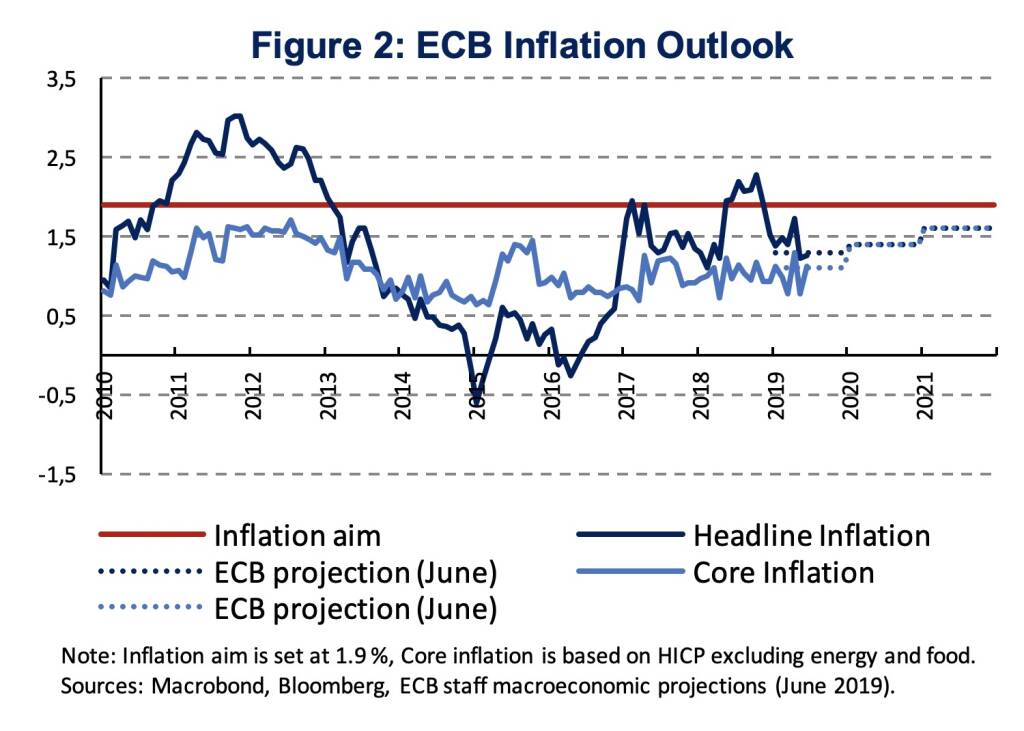
Consistent with expectations of low monetary policy interest rates, the Governing Council stressed the “need for a highly accommodative stance of monetary policy for a prolonged period of time”. Further, the ECB emphasized its determination to act “if the medium-term inflation outlook continues to fall short of its aim”. Most recent ECB projections (June) show Euro Area inflation at 1.3 % in 2019 and 1.6 % in 2021. A new set of ECB staff macroeconomic projections will be released in September. Until now, however, there is little evidence why the inflation outlook would have improved, as current readings seem to be in line with the most recent outlook. Headline inflation was 1.3 % in June, while core inflation, a better proxy for the underlying inflation trend, was 1.1 %. The ECB’s inflation aim is below but close to 2 % over the medium term, which “in a sense is 1.9 %” according the Mario Draghi. What was new in last week’s statement is the focus on symmetry. Symmetry means that there is no 2 % cap such that inflation can deviate on both sides. A short-term overshooting of inflation, therefore, does not require an immediate tightening of monetary policy.

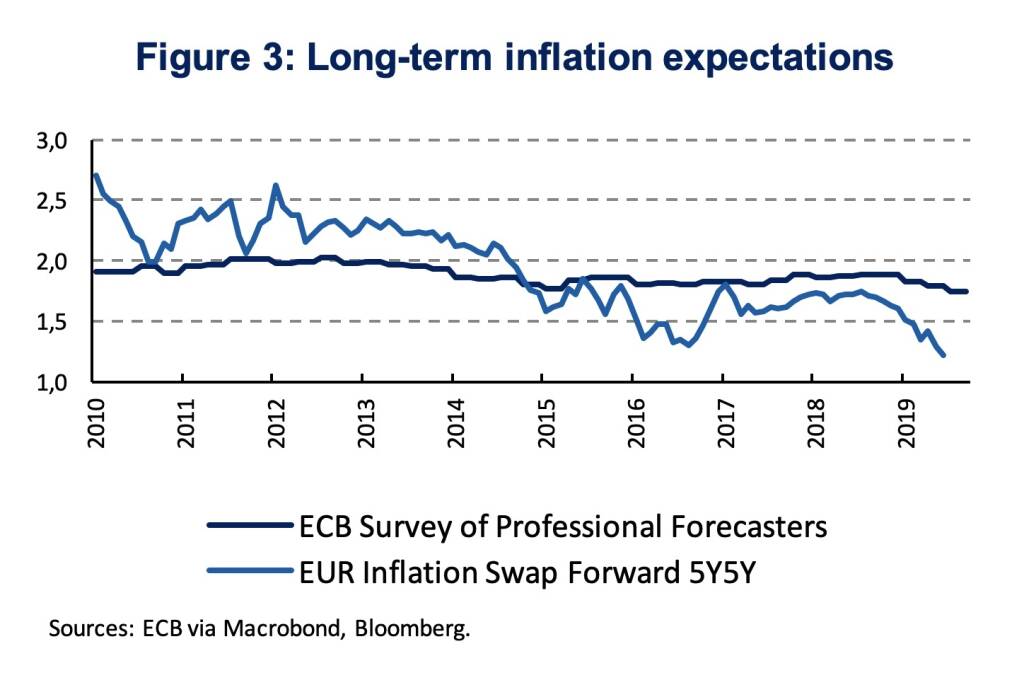
  A main driver of the medium-term inflation outlook is expected inflation. As long as firms’ and households’ expectations of future inflation remain at the ECB’s inflation target, a sustained convergence to the central bank’s aim is likely over the medium term. Hence, inflation expectations are among the key indicators of the Governing Council’s watch list. The recent deterioration of inflation expectations should, therefore, not be underestimated in driving the Governing Council’s decision to provide additional monetary policy accommodation. The development of inflation expectations can be assessed by looking at market- as well as survey-based measures. The most common long-term market-based inflation expectation measure is the five-year forward inflation-linked swap rate five years ahead, while the ECB’s survey of professional forecasters (SPF) provides a survey-based indication (Figure 3). The drop of inflation expectations has been more pronounced according to market-based measures. Survey-based inflation expectations are less volatile and have remained closer to the ECB’s inflation target. In a recent speech Benoît Cœuré, Member of the Executive Board of the ECB, has argued that market-based inflation expectations are more consistent with survey-based measures once being corrected for changes in the inflation risk premium [1]. In Q3, however, also the ECB’s SPF shows long-term inflation expectation at its lowest level (1.7 %) providing more consistent evidence of an overall drop in inflation expectations.

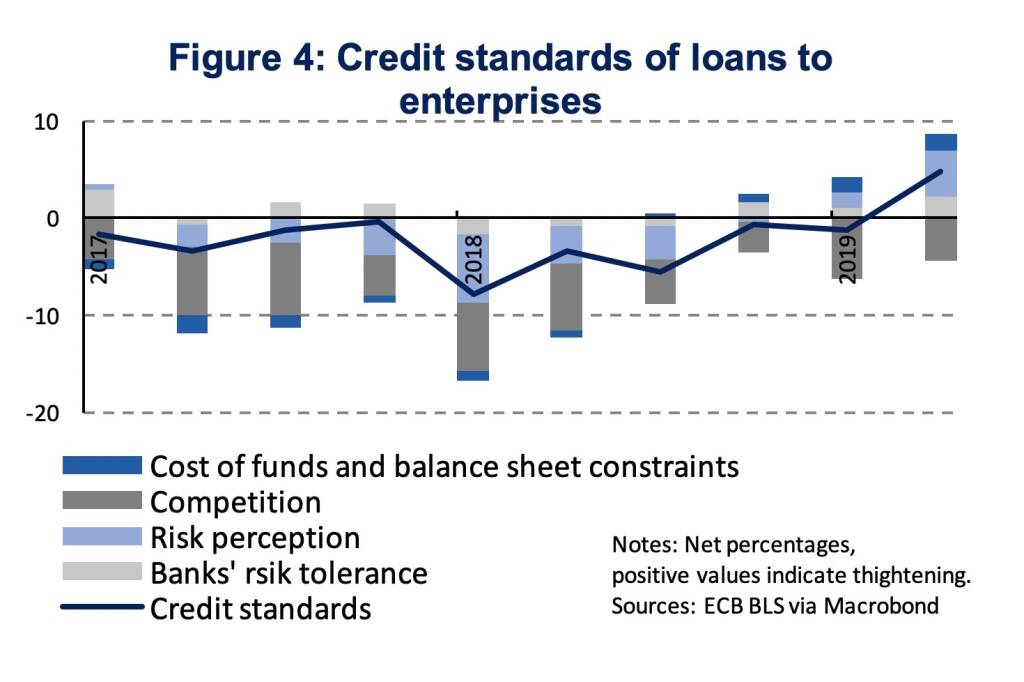
In spite of continued extensive monetary policy accommodation credit standards for loans to enterprises have tightened in the second quarter of 2019, as shown by the Euro Area most recent bank lending survey. A phase of easing credit standards has started in early 2014 with only one quarter of tightening. In Q2 credit standard tightening was predominantly driven by concerns about the economic outlook (risk perception, Figure 4), competition is easing credit standards. Demand for loans, yet, remains strong both for loans to enterprises and households.

  Risks surrounding the Euro Area growth outlook remain tilted to the downside and a rebound in H2 2019, as previously anticipated by the ECB, has become more unlikely. Economic growth was surprisingly strong during the first quarter of the year, when the Euro Area economy expanded by 0.4 % (quarter-on-quarter, seasonally adjusted), yet, signs of a slowing expansion continue to weigh on the outlook. Our Nowcasting model, which predicts quarterly GDP growth based on high frequency business cycle indicators, indicates 0.2 % quarter-on-quarter growth in Q2 2019. Preliminary figures will be released on Wednesday (31.07). 

In light of only moderate economic growth, projected medium-term inflation below the central bank’s aim and deteriorating long-term inflation expectations, the ECB has tasked its staff to examine options to provide additional monetary policy stimulus. The focus is laid on reinforcing the ECB’s forward guidance on policy rates, design mitigating measures for lowering the deposit rate and provide options for the size and composition of potential new net asset purchases. Details can be expected by September.

[1] Inflation expectations and the conduct of monetary policy, Speech by Benoît Cœuré, SAFE Policy Center, Frankfurt am Main, 11 July 2019.

Authors

Martin Ertl Franz Xaver Zobl

Chief Economist Economist

UNIQA Capital Markets GmbH UNIQA Capital Markets GmbH


(31.07.2019)

BSN Podcasts
Christian Drastil: Wiener Börse Plausch

kapitalmarkt-stimme.at daily voice: Zahlen & Fakten nach Woche 50, damit man bzgl. Wiener Börse mitreden und sie einreihen kann


Bildnachweis

1. Expectations of short-term rates

2. ECB Inflation Outlook

3. Long-term inflation expectations

4. Credit standards of loans to enterprises

5. Interest rates

Aktien auf dem Radar:VIG, UBM, FACC, Pierer Mobility, EuroTeleSites AG, RHI Magnesita, Frequentis, AT&S, Porr, Amag, Uniqa, DO&CO, Erste Group, VAS AG, Wolftank-Adisa, BKS Bank Stamm, Oberbank AG Stamm, EVN, Flughafen Wien, CPI Europe AG, Kapsch TrafficCom, Lenzing, Österreichische Post, Rosenbauer, Strabag, Telekom Austria, Continental, Münchener Rück, Hannover Rück, Fresenius Medical Care, adidas.


Random Partner

Marinomed
Marinomed hat die Vision, das Leben von Patienten, die an Krankheiten mit unzureichenden Behandlungsmöglichkeiten leiden, in zwei wichtigen therapeutischen Bereichen nachhaltig zu verbessern: Virologie und Immunologie.

>> Besuchen Sie 62 weitere Partner auf boerse-social.com/partner

ECB Inflation Outlook


Long-term inflation expectations


Credit standards of loans to enterprises


Interest rates


 Latest Blogs

» Österreich-Depots: Weekend Bilanz (Depot Kommentar)

» Börsegeschichte 12.12.: KTM, Immoeast, Robert Kastil, Michael Pistauer, ...

» Nachlese: Birgit Puck, Richard Dobetsberger, Martina Geisler, Karin Pühr...

» PIR-News: Uniqa bei Investoren, Roadshows 2026, News zu UBM, Semperit, K...

» Heute Ausgabe 2000 des #gabb, danke an Polytec! (Christian Drastil)

» Wiener Börse Party #1054: ATX erneut fester, Erste Group nur noch minima...

» Wiener Börse zu Mittag etwas fester und heute Ausgabe 2000 des #gabb: Pi...

» LinkedIn-NL: Heute Ausgabe 2000: Den täglichen Börsenbrief zur Wiener Bö...

» Börse-Inputs auf Spotify zu u.a. Birgit Puck FMA; Karin Pühringer TUDC, ...

» ATX-Trends: RBI, Erste Group, Bawag, Mayr-Melnhof ...


Useletter

Die Useletter "Morning Xpresso" und "Evening Xtrakt" heben sich deutlich von den gängigen Newslettern ab. Beispiele ansehen bzw. kostenfrei anmelden. Wichtige Börse-Infos garantiert.

Newsletter abonnieren

Runplugged

Infos über neue Financial Literacy Audio Files für die Runplugged App
(kostenfrei downloaden über http://runplugged.com/spreadit)

per Newsletter erhalten


Meistgelesen
>> mehr


PIR-Zeichnungsprodukte
Newsflow
>> mehr

Börse Social Club Board
>> mehr
    BSN MA-Event Münchener Rück
    BSN MA-Event Continental
    BSN MA-Event Münchener Rück
    BSN MA-Event Continental
    #gabb #2000

    Featured Partner Video

    kapitalmarkt-stimme.at daily voice: Warum agieren Stiftungsvorstände nur so aktienfern? Und wie wird man eigentlich Stiftungsvorstand?

    kapitalmarkt-stimme.at daily voice auf audio-cd.at. Warum agieren Stiftungsvorstände nur so aktienfern? Und wie wird man eigentlich Stiftungsvorstand? Manfred Wieland, stiftung-nextgen, hat Antwort...

    Books josefchladek.com

    Krass Clement
    Født af mørket
    2025
    Gyldendal

    Wassili und Hans Luckhardt
    Zur neuen Wohnform
    1930
    Bauwelt-Verlag

    Ció Prat i Bofill
    Milions d’estels i un somni
    2025
    Self published

    Nikola Mihov
    The Last Gift
    2025
    Self published

    Elizabeth Alderliesten
    Remember Who You Once Were
    2024
    Self published


    31.07.2019, 7095 Zeichen
    • ECB prepares new steps to provide additional monetary stimulus (lower deposit rate, QE).
    • Medium-term inflation outlook is no longer in line with ECB’s inflation aim and deterioration of inflation expectations has become more evident.
    • Moderate EA growth endures and risks remain tilted to the downside as uncertainties prolong.

    The European Central Bank (ECB) has stopped its monetary policy normalization and went into reverse before interest rates have even been raised once. Last week’s meeting has brought substantial changes to the central bank’s communication, strongly indicating additional easing measures to be introduced in September, the ECB’s next Governing Council meeting. A lowering of the deposit facility rate, currently at -0.4 %, alongside changes to the forward guidance on policy rates are likely and the launch of a new asset purchase program (QE) cannot be ruled out. The Governing Council has underlined “the need for a highly accommodative stance of monetary policy for a prolonged period of time”. The change of course responds to prolonged uncertainty in the economic outlook and inflation running persistently below the ECB’s inflation target alongside a recent deterioration of inflation expectations.

      Among the many changes to the ECB’s communication was an adjustment to the forward guidance on policy rates. The Government Council added an easing bias opening the way for lowering interest rates in September. The ECB now expects “interest rates to remain at their present or lower levels at least through the first half of 2020”. The date dependency has already been altered twice after having been introduced in June 2018, when the Governing Council expected interest rates to remain at their present levels “at least through the summer of 2019”. In March 2019 the date dependency was then shifted to the end of the year and has further been postponed to the first half of 2020 in June. Financial market expectations of the path of short-term ECB interest rates have responded accordingly by postponing the date of a possible rate hike. Figure 1 shows expected future short-term rates as of January 2018, July 2018, December 2018 and July 2019 based on 1-month overnight index swap (OIS) forwards. Most recently financial markets expect ECB interest rates to remain at or below their present levels until 2024. In early 2018, it was believed that a similar level of interest rates will already be reached by mid-2019.

    Consistent with expectations of low monetary policy interest rates, the Governing Council stressed the “need for a highly accommodative stance of monetary policy for a prolonged period of time”. Further, the ECB emphasized its determination to act “if the medium-term inflation outlook continues to fall short of its aim”. Most recent ECB projections (June) show Euro Area inflation at 1.3 % in 2019 and 1.6 % in 2021. A new set of ECB staff macroeconomic projections will be released in September. Until now, however, there is little evidence why the inflation outlook would have improved, as current readings seem to be in line with the most recent outlook. Headline inflation was 1.3 % in June, while core inflation, a better proxy for the underlying inflation trend, was 1.1 %. The ECB’s inflation aim is below but close to 2 % over the medium term, which “in a sense is 1.9 %” according the Mario Draghi. What was new in last week’s statement is the focus on symmetry. Symmetry means that there is no 2 % cap such that inflation can deviate on both sides. A short-term overshooting of inflation, therefore, does not require an immediate tightening of monetary policy.

      A main driver of the medium-term inflation outlook is expected inflation. As long as firms’ and households’ expectations of future inflation remain at the ECB’s inflation target, a sustained convergence to the central bank’s aim is likely over the medium term. Hence, inflation expectations are among the key indicators of the Governing Council’s watch list. The recent deterioration of inflation expectations should, therefore, not be underestimated in driving the Governing Council’s decision to provide additional monetary policy accommodation. The development of inflation expectations can be assessed by looking at market- as well as survey-based measures. The most common long-term market-based inflation expectation measure is the five-year forward inflation-linked swap rate five years ahead, while the ECB’s survey of professional forecasters (SPF) provides a survey-based indication (Figure 3). The drop of inflation expectations has been more pronounced according to market-based measures. Survey-based inflation expectations are less volatile and have remained closer to the ECB’s inflation target. In a recent speech Benoît Cœuré, Member of the Executive Board of the ECB, has argued that market-based inflation expectations are more consistent with survey-based measures once being corrected for changes in the inflation risk premium [1]. In Q3, however, also the ECB’s SPF shows long-term inflation expectation at its lowest level (1.7 %) providing more consistent evidence of an overall drop in inflation expectations.

    In spite of continued extensive monetary policy accommodation credit standards for loans to enterprises have tightened in the second quarter of 2019, as shown by the Euro Area most recent bank lending survey. A phase of easing credit standards has started in early 2014 with only one quarter of tightening. In Q2 credit standard tightening was predominantly driven by concerns about the economic outlook (risk perception, Figure 4), competition is easing credit standards. Demand for loans, yet, remains strong both for loans to enterprises and households.

      Risks surrounding the Euro Area growth outlook remain tilted to the downside and a rebound in H2 2019, as previously anticipated by the ECB, has become more unlikely. Economic growth was surprisingly strong during the first quarter of the year, when the Euro Area economy expanded by 0.4 % (quarter-on-quarter, seasonally adjusted), yet, signs of a slowing expansion continue to weigh on the outlook. Our Nowcasting model, which predicts quarterly GDP growth based on high frequency business cycle indicators, indicates 0.2 % quarter-on-quarter growth in Q2 2019. Preliminary figures will be released on Wednesday (31.07). 

    In light of only moderate economic growth, projected medium-term inflation below the central bank’s aim and deteriorating long-term inflation expectations, the ECB has tasked its staff to examine options to provide additional monetary policy stimulus. The focus is laid on reinforcing the ECB’s forward guidance on policy rates, design mitigating measures for lowering the deposit rate and provide options for the size and composition of potential new net asset purchases. Details can be expected by September.

    [1] Inflation expectations and the conduct of monetary policy, Speech by Benoît Cœuré, SAFE Policy Center, Frankfurt am Main, 11 July 2019.

    Authors

    Martin Ertl Franz Xaver Zobl

    Chief Economist Economist

    UNIQA Capital Markets GmbH UNIQA Capital Markets GmbH


    (31.07.2019)

    BSN Podcasts
    Christian Drastil: Wiener Börse Plausch

    kapitalmarkt-stimme.at daily voice: Zahlen & Fakten nach Woche 50, damit man bzgl. Wiener Börse mitreden und sie einreihen kann


    Bildnachweis

    1. Expectations of short-term rates

    2. ECB Inflation Outlook

    3. Long-term inflation expectations

    4. Credit standards of loans to enterprises

    5. Interest rates

    Aktien auf dem Radar:VIG, UBM, FACC, Pierer Mobility, EuroTeleSites AG, RHI Magnesita, Frequentis, AT&S, Porr, Amag, Uniqa, DO&CO, Erste Group, VAS AG, Wolftank-Adisa, BKS Bank Stamm, Oberbank AG Stamm, EVN, Flughafen Wien, CPI Europe AG, Kapsch TrafficCom, Lenzing, Österreichische Post, Rosenbauer, Strabag, Telekom Austria, Continental, Münchener Rück, Hannover Rück, Fresenius Medical Care, adidas.


    Random Partner

    Marinomed
    Marinomed hat die Vision, das Leben von Patienten, die an Krankheiten mit unzureichenden Behandlungsmöglichkeiten leiden, in zwei wichtigen therapeutischen Bereichen nachhaltig zu verbessern: Virologie und Immunologie.

    >> Besuchen Sie 62 weitere Partner auf boerse-social.com/partner

    ECB Inflation Outlook


    Long-term inflation expectations


    Credit standards of loans to enterprises


    Interest rates


     Latest Blogs

    » Österreich-Depots: Weekend Bilanz (Depot Kommentar)

    » Börsegeschichte 12.12.: KTM, Immoeast, Robert Kastil, Michael Pistauer, ...

    » Nachlese: Birgit Puck, Richard Dobetsberger, Martina Geisler, Karin Pühr...

    » PIR-News: Uniqa bei Investoren, Roadshows 2026, News zu UBM, Semperit, K...

    » Heute Ausgabe 2000 des #gabb, danke an Polytec! (Christian Drastil)

    » Wiener Börse Party #1054: ATX erneut fester, Erste Group nur noch minima...

    » Wiener Börse zu Mittag etwas fester und heute Ausgabe 2000 des #gabb: Pi...

    » LinkedIn-NL: Heute Ausgabe 2000: Den täglichen Börsenbrief zur Wiener Bö...

    » Börse-Inputs auf Spotify zu u.a. Birgit Puck FMA; Karin Pühringer TUDC, ...

    » ATX-Trends: RBI, Erste Group, Bawag, Mayr-Melnhof ...


    Useletter

    Die Useletter "Morning Xpresso" und "Evening Xtrakt" heben sich deutlich von den gängigen Newslettern ab. Beispiele ansehen bzw. kostenfrei anmelden. Wichtige Börse-Infos garantiert.

    Newsletter abonnieren

    Runplugged

    Infos über neue Financial Literacy Audio Files für die Runplugged App
    (kostenfrei downloaden über http://runplugged.com/spreadit)

    per Newsletter erhalten


    Meistgelesen
    >> mehr


    PIR-Zeichnungsprodukte
    Newsflow
    >> mehr

    Börse Social Club Board
    >> mehr
      BSN MA-Event Münchener Rück
      BSN MA-Event Continental
      BSN MA-Event Münchener Rück
      BSN MA-Event Continental
      #gabb #2000

      Featured Partner Video

      kapitalmarkt-stimme.at daily voice: Warum agieren Stiftungsvorstände nur so aktienfern? Und wie wird man eigentlich Stiftungsvorstand?

      kapitalmarkt-stimme.at daily voice auf audio-cd.at. Warum agieren Stiftungsvorstände nur so aktienfern? Und wie wird man eigentlich Stiftungsvorstand? Manfred Wieland, stiftung-nextgen, hat Antwort...

      Books josefchladek.com

      Robert Frank
      Os Americanos (first Brazilian edition)
      2017
      Instituto Moreira Salles

      Krass Clement
      Født af mørket
      2025
      Gyldendal

      Elizabeth Alderliesten
      Not Shameless
      2025
      Self published

      Paul Graham
      Beyond Caring
      1986
      Grey Editions

      Eliška Klimešová
      Women Readers
      2025
      Self published