



Ich stimme der Verwendung von Cookies zu. Auch wenn ich diese Website weiter nutze, gilt dies als Zustimmung.

Bitte lesen und akzeptieren Sie die Datenschutzinformation und Cookie-Informationen, damit Sie unser Angebot weiter nutzen können. Natürlich können Sie diese Einwilligung jederzeit widerrufen.


Economic resilience endures in CEE (Martin Ertl)

8 weitere Bilder
(mit historischen Bildtexten)

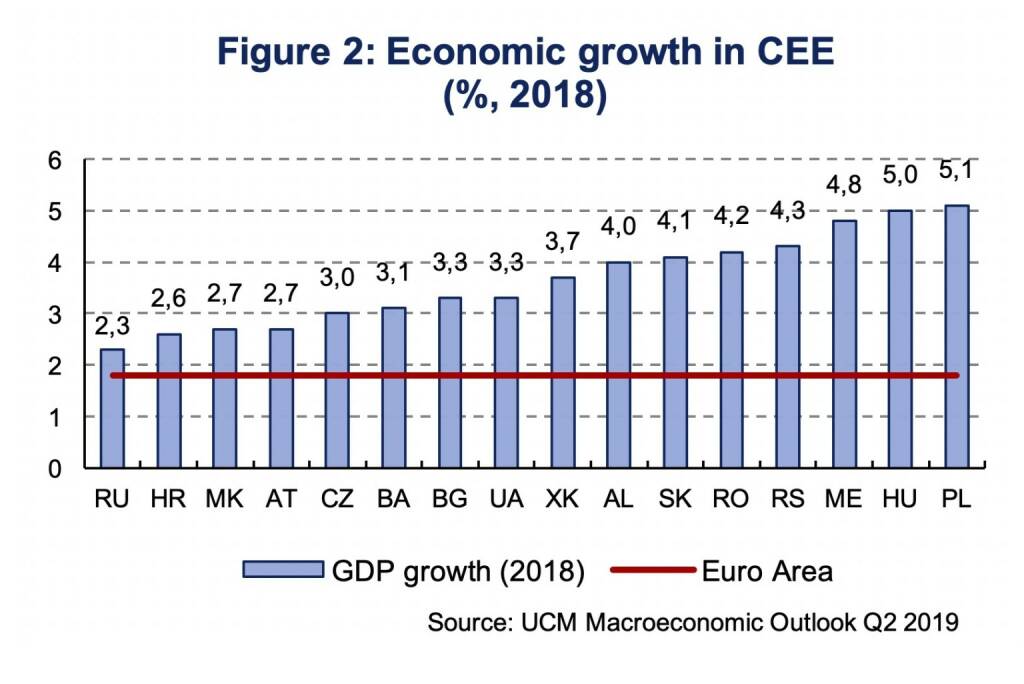
Economic growth in CEE

Domestic gross value added in gross exports

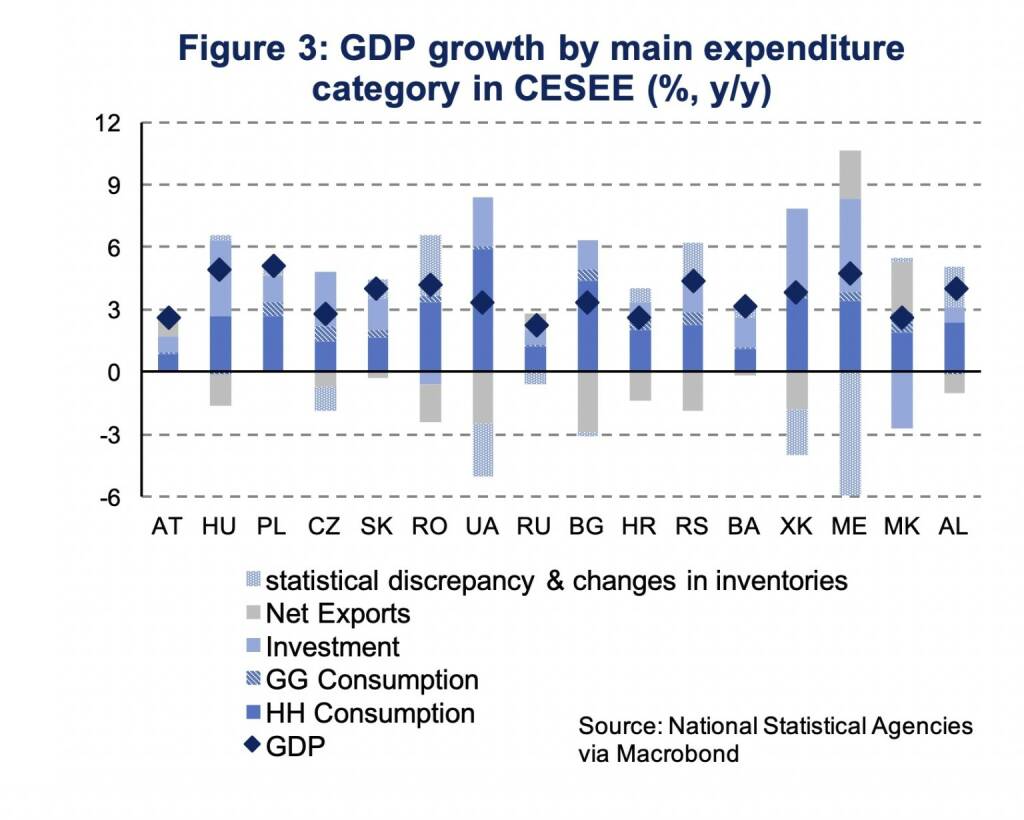
GDP growth by main expenditure category in CESEE

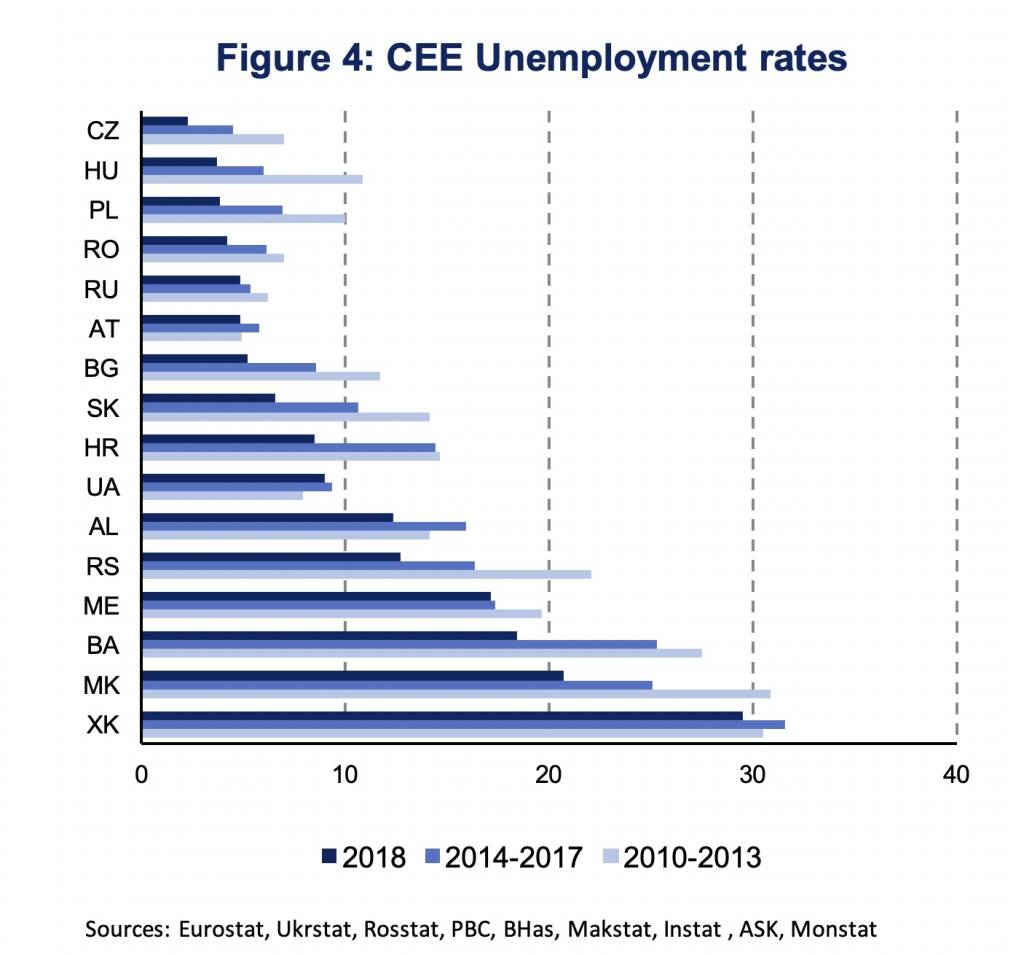
CEE Unemployment rates

Inflation Rates in CEE

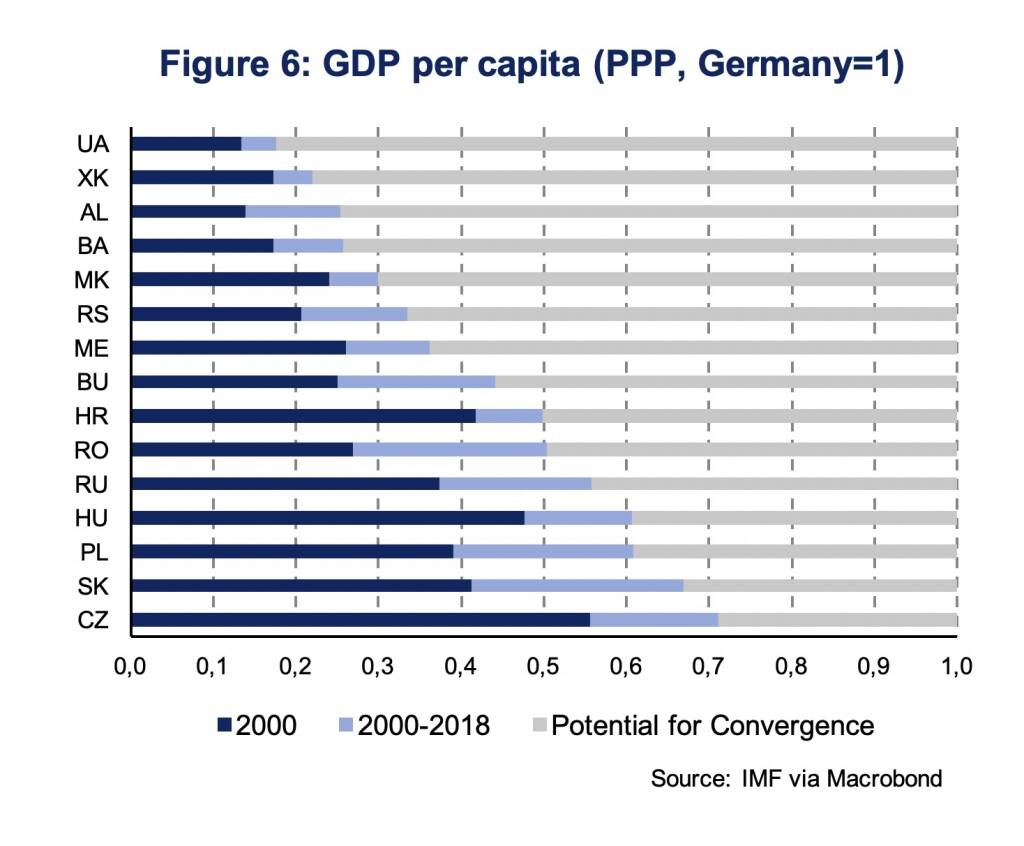
GDP per capita

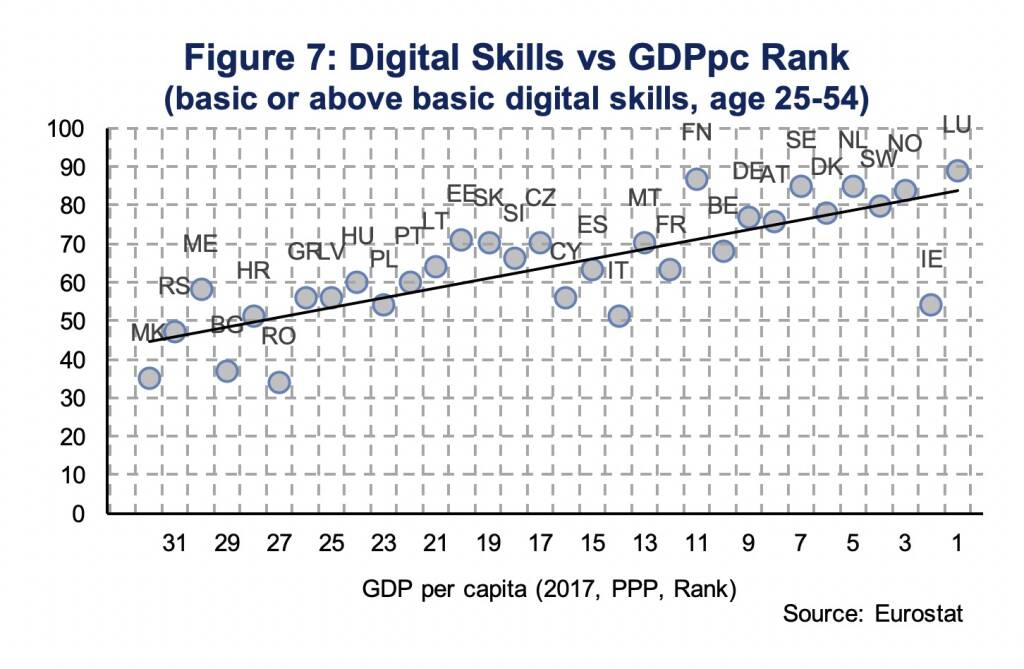
Digital Skills vs GDPpc Rank

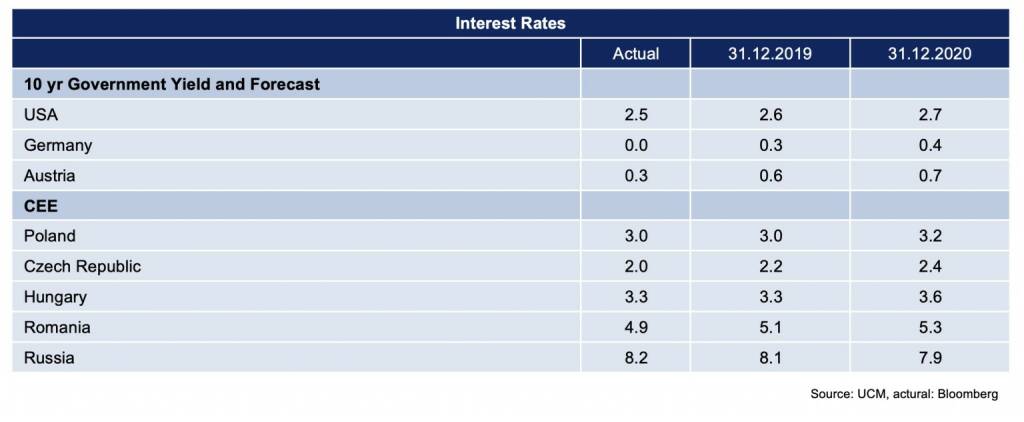
Interest Rates

Autor:
Martin Ertl

Chief Economist, UNIQA Capital Markets GmbH

>> Website


>> zur Startseite mit allen Blogs

20.05.2019, 6822 Zeichen
  • While the global and Euro Area business cycles slow, the economic expansion remains surprisingly strong in CEE.
  • The region shows a high degree of economic integration with the Euro Area, yet strong domestic demand more than compensates for the weakening external conditions.
  • Improvements in labor markets have been broad based and rising wages support household consumption as, so far, inflation remains rather muted.
  •   The region’s strong growth performance drives economic convergence. For it to persist, digital capacities will be essential to close the gap to an evolving technological frontier.

  Central and Eastern Europe (CEE) maintains a solid expansion albeit a weakening external macroeconomic environment. The expansion of the global economy has slowed to 3.6 % in 2018 after 3.8 % in 2017 and the growth outlook for 2019 has further been lowered to 3.3 % (OECD, IMF). Business sentiment has deteriorated continuously throughout the year which can further be linked to elevated levels of political uncertainty. Trade tensions between the United States and China heightened and the future EU-UK relationship remains unclear. Among developed economies, the growth slow-down was markedly felt in the Euro Area. The European Central Bank (ECB) has revised its 2019 GDP growth projection downward since mid-2018 (Figure 1). The latest ECB staff macroeconomic projections from March indicate Euro Area GDP growth at 1.1 % in 2019. The preliminary estimate of first quarter GDP growth at 0.4 % (quarter-on-quarter, seasonally adjusted), which has been released at the end of April, shows a mild gain in economic momentum compared to the second half of 2018.

While Euro Area growth slowed to 1.8 % in 2018 (2017: 2.5 %), the CEE economies, in which UNIQA operates, expanded by 3.3 % (2017: 3.0 %). Excluding Russia, our preferred aggregate, GDP growth of the region was 4.2 %. In the years ahead, we expect growth to remain solid, yet to gradually slow down (2019: 3.5 %, 2020: 3.3 %). In every single CEE economy GDP growth was above the Euro Area average, from 2.3 % in Russia to 5.1 % in Poland (Figure 2). Moreover, our real-time GDP trackers for Central Europe indicate continued growth momentum. Hence, the region’s resilience to weaker Euro Area growth is set to continue with CEE as Europe’s engine of growth.

In spite of the region’s resilience, the economies of CEE remain closely integrated into Euro Area value chains. In the Czech Republic, for instance, 55 % of domestic gross value added in exports is exported to Euro Area countries, 24.4 % to Germany alone. Among the top 10 countries with the highest Euro Area export share, in gross valued added terms, are 6 countries located within the CEE region (Table 1). Hence, if the weakness of the Euro Area business cycle endures for longer, the region will not be immune to negative spill-overs.

  So far negative effects from weaker external demand have been more than compensated by a boost in domestic demand. The structure of GDP growth in many CEE economies has increasingly shifted towards household consumption as well as investment activity. Net-exports, on the other hand, have subtracted from GDP growth in 2018, not in Montenegro and North Macedonia though (Figure 3).

Improvements in CEE labor markets have substantially contributed to the region’s resilience. In 2018, unemployment rates have been substantially lower than in previous periods, with the exception of Ukraine where the unemployment rate increased until 2017. Yet, labor markets continue to be heterogeneous. Unemployment rates range from 2.2 % in the Czech Republic to almost 29.5 % in Kosovo. They tend to be lower in European Union member states and higher at the Western Balkan (Figure 4). 

  In spite of tightening labor markets, inflationary pressure has remained rather dampened. In most CEE economies inflation is at historically low levels and at, or below, the respective central banks’ inflation targets (Figure 5). Yet, wage growth has accelerated quite substantially in a number of CEE economies, like Ukraine, Romania and Hungary, where inflationary pressure have increased lately.

    The strong business cycle has ensured economic convergence to continue. CEE economies, particularly those which have already been part of the EU, have fueled European convergence prior to the Great Recession of 2008/09. After the crisis, convergence has continued, yet, at a slower pace. Since 2000 the average EU-CEE economy has close the GDP per capita gap to Germany by 20 %-age points. Poland, for instance, had a GDP per capita of 39 % the German level in 2000, compared to 61 % in 2018 (Figure 6). Countries at the Western Balkan were less successful. Ukraine has closed the gap to Germany by 4 %, even though starting at a much lower level (13 %) than Poland. This shows that there is no guarantee for convergence. Convergence is conditional on, so called, social capacities which are vital for technological progress to diffuse. The quality of national institutions as well as a labor force equipped with the necessary skills are among the best validated examples.

Looking ahead, the innovative capacity with respect to digital technologies and processes will be vital to converge. Comparing digital skills of the labor force (age 25-54) with a country’s rank of GDP per capita, gives a descriptive indication with respect to the potential of convergence based on digital technologies (Figure 7). The positive correlation shows that richer countries tend to have a labor force which is better equipped with digital skills. However, some countries, like Central European economies (Czech Republic, Hungary and Slovakia) have a well digitally skilled labor force relative to the level of income. Other economies, like Italy and Ireland, but also Romania and Bulgaria, have an ill-equipped labor force relative to their level of income. Hence, in order to reap the full benefits of digital technologies and to be able to adapt technologies from the frontier, the latter countries will have to increase the digital skills of the work force. 

Economic resilience in CEE endures. While the global and Euro Area business cycles slow, the economic expansion remains surprisingly strong in CEE. The region shows a high degree of economic integration with the Euro Area, yet strong domestic demand more than compensates for the weakening external conditions. Improvements in labor markets have been broad based, and rising wages support household consumption as, so far, inflation has remained rather muted. The region’s strong growth performance drives economic convergence. For it to persist, digital capacities will be essential to close the gap to an evolving technological frontier.

Authors

Martin Ertl Franz Xaver Zobl

Chief Economist Economist

UNIQA Capital Markets GmbH UNIQA Capital Markets GmbH


(20.05.2019)

BSN Podcasts
Christian Drastil: Wiener Börse Plausch

Börsepeople im Podcast S22/13: Roland Meier


Bildnachweis

1. ECB projection of 2019 Euro Area GDP growth over time

2. Economic growth in CEE

3. Domestic gross value added in gross exports

4. GDP growth by main expenditure category in CESEE

5. CEE Unemployment rates

6. Inflation Rates in CEE

7. GDP per capita

8. Digital Skills vs GDPpc Rank

9. Interest Rates

Aktien auf dem Radar:VIG, UBM, FACC, Pierer Mobility, EuroTeleSites AG, RHI Magnesita, Frequentis, AT&S, Porr, Amag, Uniqa, DO&CO, Erste Group, VAS AG, Wolftank-Adisa, BKS Bank Stamm, Oberbank AG Stamm, EVN, Flughafen Wien, CPI Europe AG, Kapsch TrafficCom, Lenzing, Österreichische Post, Rosenbauer, Strabag, Telekom Austria, Continental, Münchener Rück, Hannover Rück, Fresenius Medical Care, adidas.


Random Partner

Kapsch TrafficCom
Kapsch TrafficCom ist ein Anbieter von Intelligenten Verkehrssystemen in den Bereichen Mauteinhebung, Verkehrsmanagement, Smart Urban Mobility, Verkehrssicherheit sowie vernetzte Fahrzeuge und deckt mit durchgängigen Lösungen die gesamte Wertschöpfungskette der Kunden aus einer Hand ab. Die Mobilitätslösungen von Kapsch TrafficCom helfen dabei, den Straßenverkehr in Städten und auf Autobahnen sicherer und effizienter zu machen.

>> Besuchen Sie 62 weitere Partner auf boerse-social.com/partner

Economic growth in CEE


Domestic gross value added in gross exports


GDP growth by main expenditure category in CESEE


CEE Unemployment rates


Inflation Rates in CEE


GDP per capita


Digital Skills vs GDPpc Rank


Interest Rates


 Latest Blogs

» Börsepeople im Podcast S22/13: Roland Meier

» Börse-Inputs auf Spotify zu u.a. VIG vs. Uniqa, ÖTV Lilli Tagger, Societ...

» Österreich-Depots: Weekend Bilanz (Depot Kommentar)

» Börsegeschichte 12.12.: KTM, Immoeast, Robert Kastil, Michael Pistauer, ...

» Nachlese: Birgit Puck, Richard Dobetsberger, Martina Geisler, Karin Pühr...

» PIR-News: Uniqa bei Investoren, Roadshows 2026, News zu UBM, Semperit, K...

» Heute Ausgabe 2000 des #gabb, danke an Polytec! (Christian Drastil)

» Wiener Börse Party #1054: ATX erneut fester, Erste Group nur noch minima...

» Wiener Börse zu Mittag etwas fester und heute Ausgabe 2000 des #gabb: Pi...

» LinkedIn-NL: Heute Ausgabe 2000: Den täglichen Börsenbrief zur Wiener Bö...


Useletter

Die Useletter "Morning Xpresso" und "Evening Xtrakt" heben sich deutlich von den gängigen Newslettern ab. Beispiele ansehen bzw. kostenfrei anmelden. Wichtige Börse-Infos garantiert.

Newsletter abonnieren

Runplugged

Infos über neue Financial Literacy Audio Files für die Runplugged App
(kostenfrei downloaden über http://runplugged.com/spreadit)

per Newsletter erhalten


Meistgelesen
>> mehr


PIR-Zeichnungsprodukte
Newsflow
>> mehr

Börse Social Club Board
>> mehr
    Star der Stunde: FACC 5.08%, Rutsch der Stunde: Addiko Bank -1.36%
    wikifolio-Trades Austro-Aktien 9-10: FACC(1)
    BSN Vola-Event FACC
    Star der Stunde: FACC 1.55%, Rutsch der Stunde: Amag -2.1%
    wikifolio-Trades Austro-Aktien 8-9: Kontron(3), Agrana(1)
    BSN MA-Event Münchener Rück
    BSN MA-Event Continental
    BSN MA-Event Münchener Rück
    BSN MA-Event Continental

    Featured Partner Video

    kapitalmarkt-stimme.at daily voice: Gunter Deuber zur Frage, ob nach Make ATX Great Again (neues High) nun Make ATX Greater Again folgt

    kapitalmarkt-stimme.at daily voice auf audio-cd.at: Ein Update mit Gunter Deuber, Head of Raiffeisen Research. Gestern haben wir ja nach 18 Jahren, 4 Monaten und 19 Tagen einen neuen Schlusskursre...

    Books josefchladek.com

    Eliška Klimešová
    Women Readers
    2025
    Self published

    Elizabeth Alderliesten
    Remember Who You Once Were
    2024
    Self published

    Erich Einhorn
    Im Flug nach Moskau
    1959
    Artia

    Jan Holkup
    Posedy / Hunting Stands
    2025
    PositiF

    Claudia Andujar
    Genocídio do Yanomami
    2025
    Void


    20.05.2019, 6822 Zeichen
    • While the global and Euro Area business cycles slow, the economic expansion remains surprisingly strong in CEE.
    • The region shows a high degree of economic integration with the Euro Area, yet strong domestic demand more than compensates for the weakening external conditions.
    • Improvements in labor markets have been broad based and rising wages support household consumption as, so far, inflation remains rather muted.
    •   The region’s strong growth performance drives economic convergence. For it to persist, digital capacities will be essential to close the gap to an evolving technological frontier.

      Central and Eastern Europe (CEE) maintains a solid expansion albeit a weakening external macroeconomic environment. The expansion of the global economy has slowed to 3.6 % in 2018 after 3.8 % in 2017 and the growth outlook for 2019 has further been lowered to 3.3 % (OECD, IMF). Business sentiment has deteriorated continuously throughout the year which can further be linked to elevated levels of political uncertainty. Trade tensions between the United States and China heightened and the future EU-UK relationship remains unclear. Among developed economies, the growth slow-down was markedly felt in the Euro Area. The European Central Bank (ECB) has revised its 2019 GDP growth projection downward since mid-2018 (Figure 1). The latest ECB staff macroeconomic projections from March indicate Euro Area GDP growth at 1.1 % in 2019. The preliminary estimate of first quarter GDP growth at 0.4 % (quarter-on-quarter, seasonally adjusted), which has been released at the end of April, shows a mild gain in economic momentum compared to the second half of 2018.

    While Euro Area growth slowed to 1.8 % in 2018 (2017: 2.5 %), the CEE economies, in which UNIQA operates, expanded by 3.3 % (2017: 3.0 %). Excluding Russia, our preferred aggregate, GDP growth of the region was 4.2 %. In the years ahead, we expect growth to remain solid, yet to gradually slow down (2019: 3.5 %, 2020: 3.3 %). In every single CEE economy GDP growth was above the Euro Area average, from 2.3 % in Russia to 5.1 % in Poland (Figure 2). Moreover, our real-time GDP trackers for Central Europe indicate continued growth momentum. Hence, the region’s resilience to weaker Euro Area growth is set to continue with CEE as Europe’s engine of growth.

    In spite of the region’s resilience, the economies of CEE remain closely integrated into Euro Area value chains. In the Czech Republic, for instance, 55 % of domestic gross value added in exports is exported to Euro Area countries, 24.4 % to Germany alone. Among the top 10 countries with the highest Euro Area export share, in gross valued added terms, are 6 countries located within the CEE region (Table 1). Hence, if the weakness of the Euro Area business cycle endures for longer, the region will not be immune to negative spill-overs.

      So far negative effects from weaker external demand have been more than compensated by a boost in domestic demand. The structure of GDP growth in many CEE economies has increasingly shifted towards household consumption as well as investment activity. Net-exports, on the other hand, have subtracted from GDP growth in 2018, not in Montenegro and North Macedonia though (Figure 3).

    Improvements in CEE labor markets have substantially contributed to the region’s resilience. In 2018, unemployment rates have been substantially lower than in previous periods, with the exception of Ukraine where the unemployment rate increased until 2017. Yet, labor markets continue to be heterogeneous. Unemployment rates range from 2.2 % in the Czech Republic to almost 29.5 % in Kosovo. They tend to be lower in European Union member states and higher at the Western Balkan (Figure 4). 

      In spite of tightening labor markets, inflationary pressure has remained rather dampened. In most CEE economies inflation is at historically low levels and at, or below, the respective central banks’ inflation targets (Figure 5). Yet, wage growth has accelerated quite substantially in a number of CEE economies, like Ukraine, Romania and Hungary, where inflationary pressure have increased lately.

        The strong business cycle has ensured economic convergence to continue. CEE economies, particularly those which have already been part of the EU, have fueled European convergence prior to the Great Recession of 2008/09. After the crisis, convergence has continued, yet, at a slower pace. Since 2000 the average EU-CEE economy has close the GDP per capita gap to Germany by 20 %-age points. Poland, for instance, had a GDP per capita of 39 % the German level in 2000, compared to 61 % in 2018 (Figure 6). Countries at the Western Balkan were less successful. Ukraine has closed the gap to Germany by 4 %, even though starting at a much lower level (13 %) than Poland. This shows that there is no guarantee for convergence. Convergence is conditional on, so called, social capacities which are vital for technological progress to diffuse. The quality of national institutions as well as a labor force equipped with the necessary skills are among the best validated examples.

    Looking ahead, the innovative capacity with respect to digital technologies and processes will be vital to converge. Comparing digital skills of the labor force (age 25-54) with a country’s rank of GDP per capita, gives a descriptive indication with respect to the potential of convergence based on digital technologies (Figure 7). The positive correlation shows that richer countries tend to have a labor force which is better equipped with digital skills. However, some countries, like Central European economies (Czech Republic, Hungary and Slovakia) have a well digitally skilled labor force relative to the level of income. Other economies, like Italy and Ireland, but also Romania and Bulgaria, have an ill-equipped labor force relative to their level of income. Hence, in order to reap the full benefits of digital technologies and to be able to adapt technologies from the frontier, the latter countries will have to increase the digital skills of the work force. 

    Economic resilience in CEE endures. While the global and Euro Area business cycles slow, the economic expansion remains surprisingly strong in CEE. The region shows a high degree of economic integration with the Euro Area, yet strong domestic demand more than compensates for the weakening external conditions. Improvements in labor markets have been broad based, and rising wages support household consumption as, so far, inflation has remained rather muted. The region’s strong growth performance drives economic convergence. For it to persist, digital capacities will be essential to close the gap to an evolving technological frontier.

    Authors

    Martin Ertl Franz Xaver Zobl

    Chief Economist Economist

    UNIQA Capital Markets GmbH UNIQA Capital Markets GmbH


    (20.05.2019)

    BSN Podcasts
    Christian Drastil: Wiener Börse Plausch

    Börsepeople im Podcast S22/13: Roland Meier


    Bildnachweis

    1. ECB projection of 2019 Euro Area GDP growth over time

    2. Economic growth in CEE

    3. Domestic gross value added in gross exports

    4. GDP growth by main expenditure category in CESEE

    5. CEE Unemployment rates

    6. Inflation Rates in CEE

    7. GDP per capita

    8. Digital Skills vs GDPpc Rank

    9. Interest Rates

    Aktien auf dem Radar:VIG, UBM, FACC, Pierer Mobility, EuroTeleSites AG, RHI Magnesita, Frequentis, AT&S, Porr, Amag, Uniqa, DO&CO, Erste Group, VAS AG, Wolftank-Adisa, BKS Bank Stamm, Oberbank AG Stamm, EVN, Flughafen Wien, CPI Europe AG, Kapsch TrafficCom, Lenzing, Österreichische Post, Rosenbauer, Strabag, Telekom Austria, Continental, Münchener Rück, Hannover Rück, Fresenius Medical Care, adidas.


    Random Partner

    Kapsch TrafficCom
    Kapsch TrafficCom ist ein Anbieter von Intelligenten Verkehrssystemen in den Bereichen Mauteinhebung, Verkehrsmanagement, Smart Urban Mobility, Verkehrssicherheit sowie vernetzte Fahrzeuge und deckt mit durchgängigen Lösungen die gesamte Wertschöpfungskette der Kunden aus einer Hand ab. Die Mobilitätslösungen von Kapsch TrafficCom helfen dabei, den Straßenverkehr in Städten und auf Autobahnen sicherer und effizienter zu machen.

    >> Besuchen Sie 62 weitere Partner auf boerse-social.com/partner


    Economic growth in CEE


    Domestic gross value added in gross exports


    GDP growth by main expenditure category in CESEE


    CEE Unemployment rates


    Inflation Rates in CEE


    GDP per capita


    Digital Skills vs GDPpc Rank


    Interest Rates


     Latest Blogs

    » Börsepeople im Podcast S22/13: Roland Meier

    » Börse-Inputs auf Spotify zu u.a. VIG vs. Uniqa, ÖTV Lilli Tagger, Societ...

    » Österreich-Depots: Weekend Bilanz (Depot Kommentar)

    » Börsegeschichte 12.12.: KTM, Immoeast, Robert Kastil, Michael Pistauer, ...

    » Nachlese: Birgit Puck, Richard Dobetsberger, Martina Geisler, Karin Pühr...

    » PIR-News: Uniqa bei Investoren, Roadshows 2026, News zu UBM, Semperit, K...

    » Heute Ausgabe 2000 des #gabb, danke an Polytec! (Christian Drastil)

    » Wiener Börse Party #1054: ATX erneut fester, Erste Group nur noch minima...

    » Wiener Börse zu Mittag etwas fester und heute Ausgabe 2000 des #gabb: Pi...

    » LinkedIn-NL: Heute Ausgabe 2000: Den täglichen Börsenbrief zur Wiener Bö...


    Useletter

    Die Useletter "Morning Xpresso" und "Evening Xtrakt" heben sich deutlich von den gängigen Newslettern ab. Beispiele ansehen bzw. kostenfrei anmelden. Wichtige Börse-Infos garantiert.

    Newsletter abonnieren

    Runplugged

    Infos über neue Financial Literacy Audio Files für die Runplugged App
    (kostenfrei downloaden über http://runplugged.com/spreadit)

    per Newsletter erhalten


    Meistgelesen
    >> mehr


    PIR-Zeichnungsprodukte
    Newsflow
    >> mehr

    Börse Social Club Board
    >> mehr
      Star der Stunde: FACC 5.08%, Rutsch der Stunde: Addiko Bank -1.36%
      wikifolio-Trades Austro-Aktien 9-10: FACC(1)
      BSN Vola-Event FACC
      Star der Stunde: FACC 1.55%, Rutsch der Stunde: Amag -2.1%
      wikifolio-Trades Austro-Aktien 8-9: Kontron(3), Agrana(1)
      BSN MA-Event Münchener Rück
      BSN MA-Event Continental
      BSN MA-Event Münchener Rück
      BSN MA-Event Continental

      Featured Partner Video

      kapitalmarkt-stimme.at daily voice: Gunter Deuber zur Frage, ob nach Make ATX Great Again (neues High) nun Make ATX Greater Again folgt

      kapitalmarkt-stimme.at daily voice auf audio-cd.at: Ein Update mit Gunter Deuber, Head of Raiffeisen Research. Gestern haben wir ja nach 18 Jahren, 4 Monaten und 19 Tagen einen neuen Schlusskursre...

      Books josefchladek.com

      Adriano Zanni
      Sequenze di Fabbrica
      2025
      Boring Machines

      Wassili und Hans Luckhardt
      Zur neuen Wohnform
      1930
      Bauwelt-Verlag

      Adriano Zanni
      Estratti di giorni cupi
      2025
      Boring Machines

      Julie van der Vaart
      Particles
      2025
      Origini edizioni

      Allied Forces
      Deutsche Konzentrations und Gefangenenlager : was die amerikanischen und britischen Armeen vorfanden, April 1945
      1945
      Selbstverlag