



Ich stimme der Verwendung von Cookies zu. Auch wenn ich diese Website weiter nutze, gilt dies als Zustimmung.

Bitte lesen und akzeptieren Sie die Datenschutzinformation und Cookie-Informationen, damit Sie unser Angebot weiter nutzen können. Natürlich können Sie diese Einwilligung jederzeit widerrufen.


Does the US economy need a mid-cycle adjustment? (Martin Ertl)

4 weitere Bilder
(mit historischen Bildtexten)

US Labor Market (non-farm payrolls)

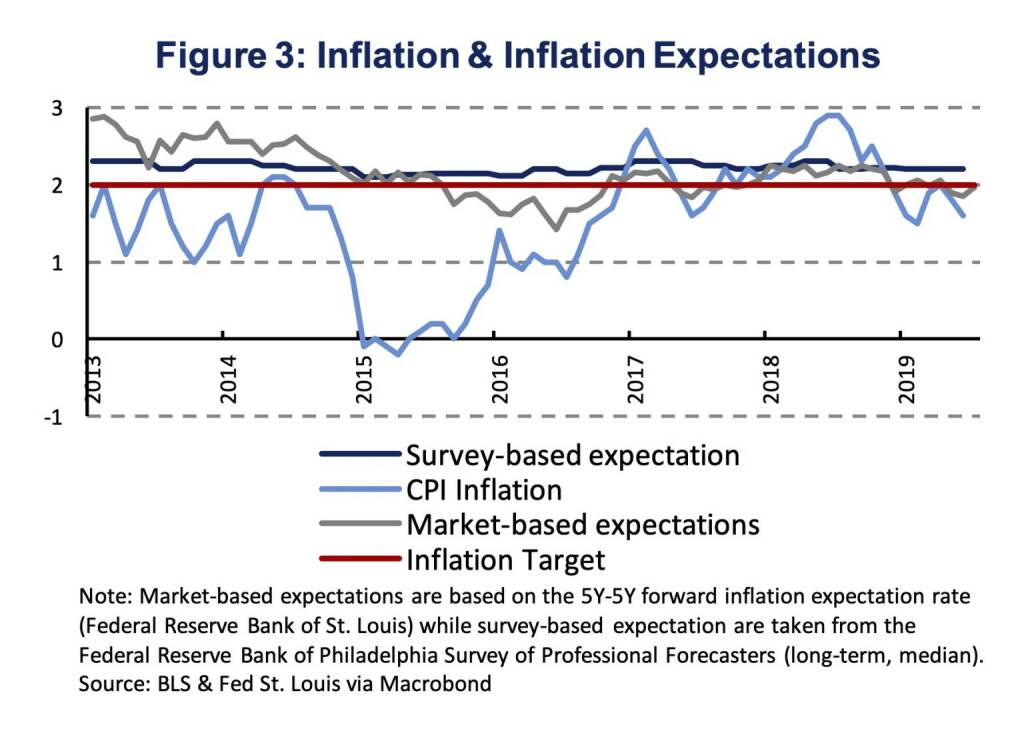
Inflation & Inflation Expectations

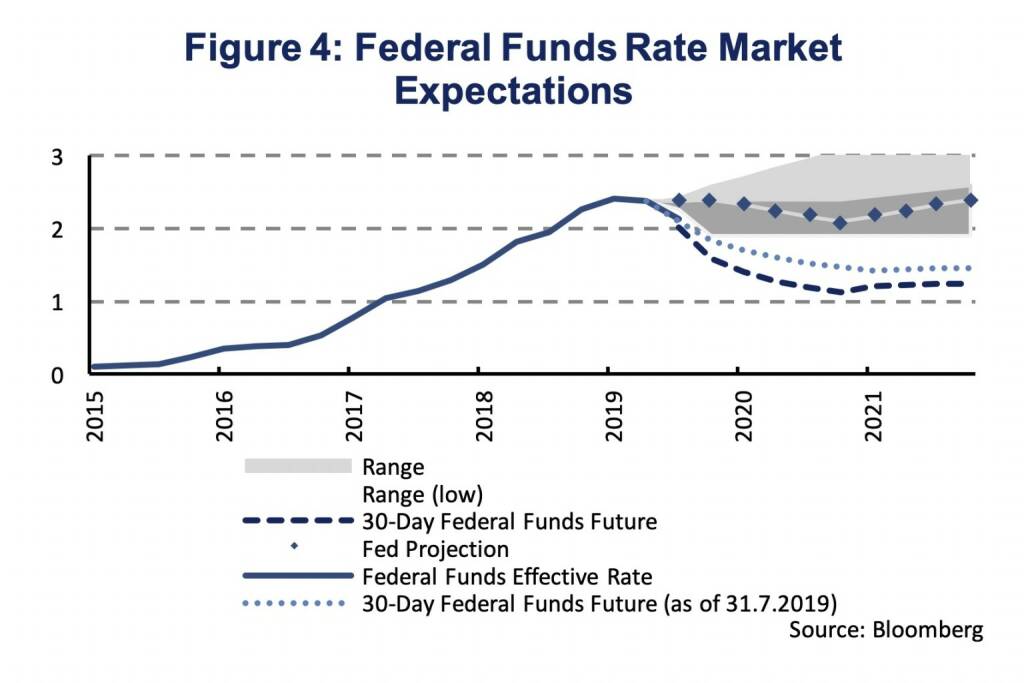
Federal Funds Rate Market Expectations

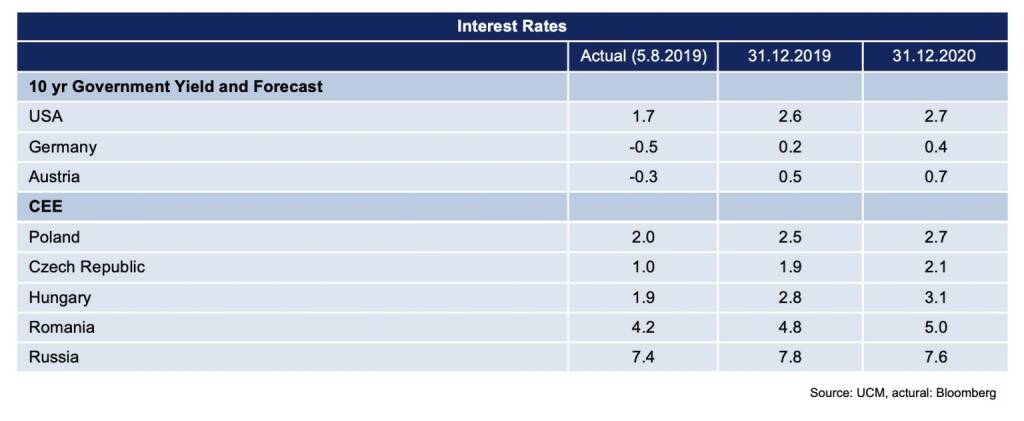
Interest Rates

Autor:
Martin Ertl

Chief Economist, UNIQA Capital Markets GmbH

>> Website


>> zur Startseite mit allen Blogs

06.08.2019, 7363 Zeichen
  • The US business cycle remains healthy, despite being the longest in history.
  • Personal consumption drives the expansion, supported by a strong labor market. 
  • Fed lowered interest rate to 2.25 %, in light of trade related uncertainty and downside risks to the outlook.
  • There is no clear-cut monetary policy case for the Fed’s mid-cycle adjustment, which remains ambiguous also within the FOMC.

  The US economy continues its longest expansion since the end of WW II, exceeding the Great Moderation (03/1991-02/2001) by two months. The Bureau of Economic Analysis (BEA) has recently released its preliminary estimate of gross domestic product (GDP) for the second quarter of 2019 (Q2 19) at 2.1 % (seasonally adjusted at annual rates). With GDP growth at 3.1 % in Q1 2019, the US economy has expanded more rapidly during the first half of the year (2.6 %) than it did in 2018 (2.5 %, quarterly average). Thus, even though, growth has moderated somewhat in Q2 19, overall, the US economy is expanding at a solid rate.

  Private consumption has been the main driver of GDP growth during the second quarter, contributing 2.85 %-age points (Figure 1). Also, government consumption, mainly federal nondefense expenditures, added to GDP growth (0.85 %-age points). Other factors subtracted from growth. Private investment declined and so did net exports. The decline in fixed investment, however, is less severe than it might seem, as changes in inventories led the decline (-0.86 %-age points). Net exports subtracted 0.65 %-age points from GDP growth with exports declining while imports stagnating.

The economy is supported by a strong labor market at full-employment and solid wage growth. In July, only 3.7 % of the US labor force was without a job and employment is further expanding. The Bureau of Labor Statistics reported that 164 thousand nonfarm jobs were created in July which is below, but close to, the benchmark of 200 thousand (Figure 2). Notable employment gains were reported in some service industries (professional and technical services, health care, social assistance and financial services) while employment in the manufacturing sector has not changed materially. In 2018 employment gains had averaged 223 thousand per month. In contrast, wage growth has not slowed down. Average hourly earnings increased by 3.2 % in July (y/y) which is in line with the average over the past 6 months. As long as the picture of low unemployment, steady job creation and solid wage gains prolongs, it is fair to assume that private consumption will further support the US expansion.

Based on already available business cycle indicators for the third quarter of 2019, the US economy is expected to grow between 1.6 (NY Fed) and 1.9 % (Atlanta Fed) in Q3. Similar to the previous quarter, consumer spending is expected to be the main growth driver. If a similar pace can be maintained in Q4, the US economy would grow by 2.3 % in 2019. The Federal Reserve Board members and Federal Reserve Bank presidents have projected GDP growth at 2.1 % for the year 2019, based on their assessment in June (median of Fed Economic Projections). Thus, it might well be that US growth tops previous estimates.

Given the state of the US economy it might, thus, come as a surprise that the Federal Reserve Bank (Fed) has decided to ease monetary conditions. Last week, the Federal Open Market Committee (FOMC) decreased the federal funds rate by 25 basis points (bp) to range between 2.0 and 2.25 %. It has been the first interest rate cut since December 2008 when the Fed lowered the federal funds rate to range between 0 and 0.25 %. Moreover, it marks the end of an interest rate hiking cycle which started in December 2015 and ended three years later in December last year.

  So, why did the Fed decide to loosen monetary policy, in spite of, the favorable economic outlook? One reason is inflation. The Fed’s preferred inflation gauge, the deflator of personal consumption expenditures, runs well below the Fed’s 2 % inflation target, currently at 1.4 % (June). The same holds for consumer price (CPI) inflation which is only marginally higher at 1.6 % (June). More importantly, though, is the inflation outlook, which is, predominantly, driven by expectations about future price developments as well as the expected state of the economy. Measures of inflation expectations can be derived from financial markets (market-based) as well as surveys (survey-based). Market-based inflation expectations tend to be more volatile than survey-based measures, as they carry a time-varying risk premium component. In the United States, survey-based inflation expectations remain well-anchored at the Fed’s inflation target (Figure 3). Market-based inflation expectations are currently below the inflation target, though, can move back to 2 % very quickly as happened in July. The FOMC members expect inflation to converge to the 2 % target by 2021, also being facilitated by a lower federal funds rate.

Besides promoting a faster return to the inflation target, President Powell justified the decrease in the federal funds rate as an insurance “against downside risks from weak global growth and trade policy uncertainties”. It was further emphasized that the rate cut should not be interpreted as the start of an extensive cutting cycle but rather as a mid-cycle adjustment to prolong the economic expansion. Previous mid-cycle adjustments consisted of three rate cuts. The federal funds rate was lowered from 6 % to 5.25 % in 1995/96 and again from 5.5 to 4.75 % in 1998. Financial market expectations of the future path of the federal funds rate imply two more rate cuts in 2019 and one-to-two cuts in 2020 (Figure 4). Thus, markets currently expect a more aggressive monetary easing than past mid-cycle adjustments would imply. As previously the FOMC statement emphasized that the future path of the federal funds rate will be data-dependent. At the press conference, Powell emphasized the importance of trade tensions and the limited experience central bankers’ have regarding their broader macroeconomic implications. “It’s learning-by-doing”, so Powell.

The US economy is healthy and well-balanced. Yet, global factors, predominantly trade policy disruptions, put downside risks to the outlook. Uncertainty undermines business confidence, whose effects on output the Fed finds difficult to assess. The ISM manufacturing Purchasing Manager Index (PMI), a leading business sentiment indicator, has dropped to its lowest level since August 2016 (51.2 in July). In light of deteriorating global trade, demand is weak in the manufacturing sector and so is business investment. The Fed’s insurance cut was, therefore, predominantly driven by uncertainties regarding the global outlook rather than the current state of the US economy. 

Whether the Fed’s mid-cycle adjustment to a somewhat more accommodative stance of monetary policy was necessary, remains ambiguous. It is definitely not a clear-cut case for monetary policy intervention. Two members of the FOMC (Esther George and Eric Rosengren) would have preferred to keep the federal funds rate constant. The Fed has delivered, at least partly, to the frontrunning of financial markets and President Trump’s wish for lower interest rates.

Authors

Martin Ertl Franz Xaver Zobl

Chief Economist Economist

UNIQA Capital Markets GmbH UNIQA Capital Markets GmbH


(06.08.2019)

BSN Podcasts
Christian Drastil: Wiener Börse Plausch

Börsepeople im Podcast S22/13: Roland Meier


Bildnachweis

1. GDP growth by main expenditure components

2. US Labor Market (non-farm payrolls)

3. Inflation & Inflation Expectations

4. Federal Funds Rate Market Expectations

5. Interest Rates

Aktien auf dem Radar:VIG, UBM, FACC, Pierer Mobility, EuroTeleSites AG, RHI Magnesita, Frequentis, AT&S, Porr, Amag, Uniqa, DO&CO, Erste Group, VAS AG, Wolftank-Adisa, BKS Bank Stamm, Oberbank AG Stamm, EVN, Flughafen Wien, CPI Europe AG, Kapsch TrafficCom, Lenzing, Österreichische Post, Rosenbauer, Strabag, Telekom Austria, Continental, Münchener Rück, Hannover Rück, Fresenius Medical Care, adidas.


Random Partner

Semperit
Die börsennotierte Semperit AG Holding ist eine international ausgerichtete Unternehmensgruppe, die mit ihren beiden Divisionen Semperit Industrial Applications und Semperit Engineered Applications Produkte aus Kautschuk entwickelt, produziert und in über 100 Ländern weltweit vertreibt.

>> Besuchen Sie 62 weitere Partner auf boerse-social.com/partner


US Labor Market (non-farm payrolls)


Inflation & Inflation Expectations


Federal Funds Rate Market Expectations


Interest Rates


 Latest Blogs

» Wiener Börse zu Mittag fester: Frequentis, VIG und Wienerberger gesucht

» Börsepeople im Podcast S22/13: Roland Meier

» Börse-Inputs auf Spotify zu u.a. VIG vs. Uniqa, ÖTV Lilli Tagger, Societ...

» Österreich-Depots: Weekend Bilanz (Depot Kommentar)

» Börsegeschichte 12.12.: KTM, Immoeast, Robert Kastil, Michael Pistauer, ...

» Nachlese: Birgit Puck, Richard Dobetsberger, Martina Geisler, Karin Pühr...

» PIR-News: Uniqa bei Investoren, Roadshows 2026, News zu UBM, Semperit, K...

» Heute Ausgabe 2000 des #gabb, danke an Polytec! (Christian Drastil)

» Wiener Börse Party #1054: ATX erneut fester, Erste Group nur noch minima...

» Wiener Börse zu Mittag etwas fester und heute Ausgabe 2000 des #gabb: Pi...


Useletter

Die Useletter "Morning Xpresso" und "Evening Xtrakt" heben sich deutlich von den gängigen Newslettern ab. Beispiele ansehen bzw. kostenfrei anmelden. Wichtige Börse-Infos garantiert.

Newsletter abonnieren

Runplugged

Infos über neue Financial Literacy Audio Files für die Runplugged App
(kostenfrei downloaden über http://runplugged.com/spreadit)

per Newsletter erhalten


Meistgelesen
>> mehr


PIR-Zeichnungsprodukte
Newsflow
>> mehr

Börse Social Club Board
>> mehr
    wikifolio-Trades Austro-Aktien 12-13: RBI(1), Agrana(1), Frequentis(1), Wienerberger(1)
    Star der Stunde: Frequentis 1.48%, Rutsch der Stunde: FACC -0.91%
    wikifolio-Trades Austro-Aktien 11-12: Agrana(2), RBI(1), Verbund(1), Porr(1)
    BSN MA-Event Henkel
    Star der Stunde: Polytec Group 1.68%, Rutsch der Stunde: FACC -1.47%
    wikifolio-Trades Austro-Aktien 10-11: Kontron(1), Wienerberger(1), FACC(1)
    Star der Stunde: FACC 5.08%, Rutsch der Stunde: Addiko Bank -1.36%
    wikifolio-Trades Austro-Aktien 9-10: FACC(1)
    BSN Vola-Event FACC

    Featured Partner Video

    ABC Audio Business Chart #148: Globaler Wirtschaftsausblick und ein schwächelnder Riese (Josef Obergantschnig)

    Der Herbst ist die Zeit der großen Ausblicke. Institutionen weltweit legen ihre Prognosen für 2026 auf den Tisch. Für mich bleibt der World Economic Outlook des IWF der solide Referenzpunkt. In die...

    Books josefchladek.com

    Regina Anzenberger
    The Australian Journey
    2025
    AnzenbergerEdition

    Julie van der Vaart
    Particles
    2025
    Origini edizioni

    Ció Prat i Bofill
    Milions d’estels i un somni
    2025
    Self published

    Eliška Klimešová
    Women Readers
    2025
    Self published

    Claudia Andujar
    Genocídio do Yanomami
    2025
    Void


    06.08.2019, 7363 Zeichen
    • The US business cycle remains healthy, despite being the longest in history.
    • Personal consumption drives the expansion, supported by a strong labor market. 
    • Fed lowered interest rate to 2.25 %, in light of trade related uncertainty and downside risks to the outlook.
    • There is no clear-cut monetary policy case for the Fed’s mid-cycle adjustment, which remains ambiguous also within the FOMC.

      The US economy continues its longest expansion since the end of WW II, exceeding the Great Moderation (03/1991-02/2001) by two months. The Bureau of Economic Analysis (BEA) has recently released its preliminary estimate of gross domestic product (GDP) for the second quarter of 2019 (Q2 19) at 2.1 % (seasonally adjusted at annual rates). With GDP growth at 3.1 % in Q1 2019, the US economy has expanded more rapidly during the first half of the year (2.6 %) than it did in 2018 (2.5 %, quarterly average). Thus, even though, growth has moderated somewhat in Q2 19, overall, the US economy is expanding at a solid rate.

      Private consumption has been the main driver of GDP growth during the second quarter, contributing 2.85 %-age points (Figure 1). Also, government consumption, mainly federal nondefense expenditures, added to GDP growth (0.85 %-age points). Other factors subtracted from growth. Private investment declined and so did net exports. The decline in fixed investment, however, is less severe than it might seem, as changes in inventories led the decline (-0.86 %-age points). Net exports subtracted 0.65 %-age points from GDP growth with exports declining while imports stagnating.

    The economy is supported by a strong labor market at full-employment and solid wage growth. In July, only 3.7 % of the US labor force was without a job and employment is further expanding. The Bureau of Labor Statistics reported that 164 thousand nonfarm jobs were created in July which is below, but close to, the benchmark of 200 thousand (Figure 2). Notable employment gains were reported in some service industries (professional and technical services, health care, social assistance and financial services) while employment in the manufacturing sector has not changed materially. In 2018 employment gains had averaged 223 thousand per month. In contrast, wage growth has not slowed down. Average hourly earnings increased by 3.2 % in July (y/y) which is in line with the average over the past 6 months. As long as the picture of low unemployment, steady job creation and solid wage gains prolongs, it is fair to assume that private consumption will further support the US expansion.

    Based on already available business cycle indicators for the third quarter of 2019, the US economy is expected to grow between 1.6 (NY Fed) and 1.9 % (Atlanta Fed) in Q3. Similar to the previous quarter, consumer spending is expected to be the main growth driver. If a similar pace can be maintained in Q4, the US economy would grow by 2.3 % in 2019. The Federal Reserve Board members and Federal Reserve Bank presidents have projected GDP growth at 2.1 % for the year 2019, based on their assessment in June (median of Fed Economic Projections). Thus, it might well be that US growth tops previous estimates.

    Given the state of the US economy it might, thus, come as a surprise that the Federal Reserve Bank (Fed) has decided to ease monetary conditions. Last week, the Federal Open Market Committee (FOMC) decreased the federal funds rate by 25 basis points (bp) to range between 2.0 and 2.25 %. It has been the first interest rate cut since December 2008 when the Fed lowered the federal funds rate to range between 0 and 0.25 %. Moreover, it marks the end of an interest rate hiking cycle which started in December 2015 and ended three years later in December last year.

      So, why did the Fed decide to loosen monetary policy, in spite of, the favorable economic outlook? One reason is inflation. The Fed’s preferred inflation gauge, the deflator of personal consumption expenditures, runs well below the Fed’s 2 % inflation target, currently at 1.4 % (June). The same holds for consumer price (CPI) inflation which is only marginally higher at 1.6 % (June). More importantly, though, is the inflation outlook, which is, predominantly, driven by expectations about future price developments as well as the expected state of the economy. Measures of inflation expectations can be derived from financial markets (market-based) as well as surveys (survey-based). Market-based inflation expectations tend to be more volatile than survey-based measures, as they carry a time-varying risk premium component. In the United States, survey-based inflation expectations remain well-anchored at the Fed’s inflation target (Figure 3). Market-based inflation expectations are currently below the inflation target, though, can move back to 2 % very quickly as happened in July. The FOMC members expect inflation to converge to the 2 % target by 2021, also being facilitated by a lower federal funds rate.

    Besides promoting a faster return to the inflation target, President Powell justified the decrease in the federal funds rate as an insurance “against downside risks from weak global growth and trade policy uncertainties”. It was further emphasized that the rate cut should not be interpreted as the start of an extensive cutting cycle but rather as a mid-cycle adjustment to prolong the economic expansion. Previous mid-cycle adjustments consisted of three rate cuts. The federal funds rate was lowered from 6 % to 5.25 % in 1995/96 and again from 5.5 to 4.75 % in 1998. Financial market expectations of the future path of the federal funds rate imply two more rate cuts in 2019 and one-to-two cuts in 2020 (Figure 4). Thus, markets currently expect a more aggressive monetary easing than past mid-cycle adjustments would imply. As previously the FOMC statement emphasized that the future path of the federal funds rate will be data-dependent. At the press conference, Powell emphasized the importance of trade tensions and the limited experience central bankers’ have regarding their broader macroeconomic implications. “It’s learning-by-doing”, so Powell.

    The US economy is healthy and well-balanced. Yet, global factors, predominantly trade policy disruptions, put downside risks to the outlook. Uncertainty undermines business confidence, whose effects on output the Fed finds difficult to assess. The ISM manufacturing Purchasing Manager Index (PMI), a leading business sentiment indicator, has dropped to its lowest level since August 2016 (51.2 in July). In light of deteriorating global trade, demand is weak in the manufacturing sector and so is business investment. The Fed’s insurance cut was, therefore, predominantly driven by uncertainties regarding the global outlook rather than the current state of the US economy. 

    Whether the Fed’s mid-cycle adjustment to a somewhat more accommodative stance of monetary policy was necessary, remains ambiguous. It is definitely not a clear-cut case for monetary policy intervention. Two members of the FOMC (Esther George and Eric Rosengren) would have preferred to keep the federal funds rate constant. The Fed has delivered, at least partly, to the frontrunning of financial markets and President Trump’s wish for lower interest rates.

    Authors

    Martin Ertl Franz Xaver Zobl

    Chief Economist Economist

    UNIQA Capital Markets GmbH UNIQA Capital Markets GmbH


    (06.08.2019)

    BSN Podcasts
    Christian Drastil: Wiener Börse Plausch

    Börsepeople im Podcast S22/13: Roland Meier


    Bildnachweis

    1. GDP growth by main expenditure components

    2. US Labor Market (non-farm payrolls)

    3. Inflation & Inflation Expectations

    4. Federal Funds Rate Market Expectations

    5. Interest Rates

    Aktien auf dem Radar:VIG, UBM, FACC, Pierer Mobility, EuroTeleSites AG, RHI Magnesita, Frequentis, AT&S, Porr, Amag, Uniqa, DO&CO, Erste Group, VAS AG, Wolftank-Adisa, BKS Bank Stamm, Oberbank AG Stamm, EVN, Flughafen Wien, CPI Europe AG, Kapsch TrafficCom, Lenzing, Österreichische Post, Rosenbauer, Strabag, Telekom Austria, Continental, Münchener Rück, Hannover Rück, Fresenius Medical Care, adidas.


    Random Partner

    Semperit
    Die börsennotierte Semperit AG Holding ist eine international ausgerichtete Unternehmensgruppe, die mit ihren beiden Divisionen Semperit Industrial Applications und Semperit Engineered Applications Produkte aus Kautschuk entwickelt, produziert und in über 100 Ländern weltweit vertreibt.

    >> Besuchen Sie 62 weitere Partner auf boerse-social.com/partner

    US Labor Market (non-farm payrolls)


    Inflation & Inflation Expectations


    Federal Funds Rate Market Expectations


    Interest Rates


     Latest Blogs

    » Wiener Börse zu Mittag fester: Frequentis, VIG und Wienerberger gesucht

    » Börsepeople im Podcast S22/13: Roland Meier

    » Börse-Inputs auf Spotify zu u.a. VIG vs. Uniqa, ÖTV Lilli Tagger, Societ...

    » Österreich-Depots: Weekend Bilanz (Depot Kommentar)

    » Börsegeschichte 12.12.: KTM, Immoeast, Robert Kastil, Michael Pistauer, ...

    » Nachlese: Birgit Puck, Richard Dobetsberger, Martina Geisler, Karin Pühr...

    » PIR-News: Uniqa bei Investoren, Roadshows 2026, News zu UBM, Semperit, K...

    » Heute Ausgabe 2000 des #gabb, danke an Polytec! (Christian Drastil)

    » Wiener Börse Party #1054: ATX erneut fester, Erste Group nur noch minima...

    » Wiener Börse zu Mittag etwas fester und heute Ausgabe 2000 des #gabb: Pi...


    Useletter

    Die Useletter "Morning Xpresso" und "Evening Xtrakt" heben sich deutlich von den gängigen Newslettern ab. Beispiele ansehen bzw. kostenfrei anmelden. Wichtige Börse-Infos garantiert.

    Newsletter abonnieren

    Runplugged

    Infos über neue Financial Literacy Audio Files für die Runplugged App
    (kostenfrei downloaden über http://runplugged.com/spreadit)

    per Newsletter erhalten


    Meistgelesen
    >> mehr


    PIR-Zeichnungsprodukte
    Newsflow
    >> mehr

    Börse Social Club Board
    >> mehr
      wikifolio-Trades Austro-Aktien 12-13: RBI(1), Agrana(1), Frequentis(1), Wienerberger(1)
      Star der Stunde: Frequentis 1.48%, Rutsch der Stunde: FACC -0.91%
      wikifolio-Trades Austro-Aktien 11-12: Agrana(2), RBI(1), Verbund(1), Porr(1)
      BSN MA-Event Henkel
      Star der Stunde: Polytec Group 1.68%, Rutsch der Stunde: FACC -1.47%
      wikifolio-Trades Austro-Aktien 10-11: Kontron(1), Wienerberger(1), FACC(1)
      Star der Stunde: FACC 5.08%, Rutsch der Stunde: Addiko Bank -1.36%
      wikifolio-Trades Austro-Aktien 9-10: FACC(1)
      BSN Vola-Event FACC

      Featured Partner Video

      ABC Audio Business Chart #148: Globaler Wirtschaftsausblick und ein schwächelnder Riese (Josef Obergantschnig)

      Der Herbst ist die Zeit der großen Ausblicke. Institutionen weltweit legen ihre Prognosen für 2026 auf den Tisch. Für mich bleibt der World Economic Outlook des IWF der solide Referenzpunkt. In die...

      Books josefchladek.com

      Bernhard Fuchs
      Heustock
      2025
      Verlag der Buchhandlung Walther König

      Konrad Werner Schulze
      Der Stahlskelettbau
      1928
      Wissenschaftl. Verlag Dr. Zaugg & Co.

      Sasha & Cami Stone
      Femmes. Collection d'études photographiques du corps humain
      1933
      Arts et Métiers Graphiques

      Julie van der Vaart
      Particles
      2025
      Origini edizioni

      Wassili und Hans Luckhardt
      Zur neuen Wohnform
      1930
      Bauwelt-Verlag