




Ich stimme der Verwendung von Cookies zu. Auch wenn ich diese Website weiter nutze, gilt dies als Zustimmung.

Bitte lesen und akzeptieren Sie die Datenschutzinformation und Cookie-Informationen, damit Sie unser Angebot weiter nutzen können. Natürlich können Sie diese Einwilligung jederzeit widerrufen.


The threat of extended US sanctions on Russia (Martin Ertl)

4 weitere Bilder
(mit historischen Bildtexten)

Consumer surveys

Inflation expectations survey

FX Reserves

Interest Rates

Autor:
Martin Ertl

Chief Economist, UNIQA Capital Markets GmbH

>> Website


>> zur Startseite mit allen Blogs

22.01.2018, 5088 Zeichen

CEE: Russia

  •   Threat of further US sanctions downplayed by market participants
  • While the recovery has been weak, several factors support macroeconomic stability.

In August 2017, US President Trump signed the “Countering America’s Adversaries Through Sanctions Act” that instructed the US Treasury department to prepare reports for submission to congress. With respect to sanctions against the Russian Federation, the treasury was asked to report on potential effects of expanding sanctions to include sovereign debt.  Furthermore, the report is on sanctions against “parastatal entities” and “senior political figures and oligarchs”. The report from the Treasury department is expected by February to be published and submitted to congressional committees. Based on the report, the congress is going to decide on further sanctions. 

It should be stressed that it is unclear from the current stand point whether sanctions would be extended and to what extent government bonds would be included.   US sanctions on government bonds of the Russian Federation could concern the local bond market denominated in ruble (OFZ) and the international Eurobond market. With respect to the OFZ market, market observers discuss two possibilities: A ban could concern new issuance where only a tiny size of the total market would be hit. On the other side, the inclusion of the total outstanding market is considered as a worst-case scenario with severe implications for the economy. Market participants see a very low probability that the OFZ will be subject to a ban. The domestic debt market has grown strongly (Figure 1) and, in November, around 1/3 of the market was held by non-residents abroad (2.2 trn RUB or 38.6 bn USD) according to the Central Bank of Russia (CBR). Though it seems a more likely scenario, a ban of Russian Eurobonds (securities sold in hard currency in the international bond market) might be rather ineffective. Total Eurobond principal repayments amount to 5.9 bn USD in 2018. The total amount outstanding adds up to 37.3 bn USD. 

While the recovery of the Russian economy has been weak, a number of factors contribute to increased macroeconomic stability. In Q3 2017, real GDP growth had slowed (1.8 % y/y) compared to the preceding quarter (2.5 %). Economic growth has predominately been driven by the recovery in private consumption (+5.8 % y/y in Q3), while net exports subtracted from GDP growth. Fixed investment is building slowly. 

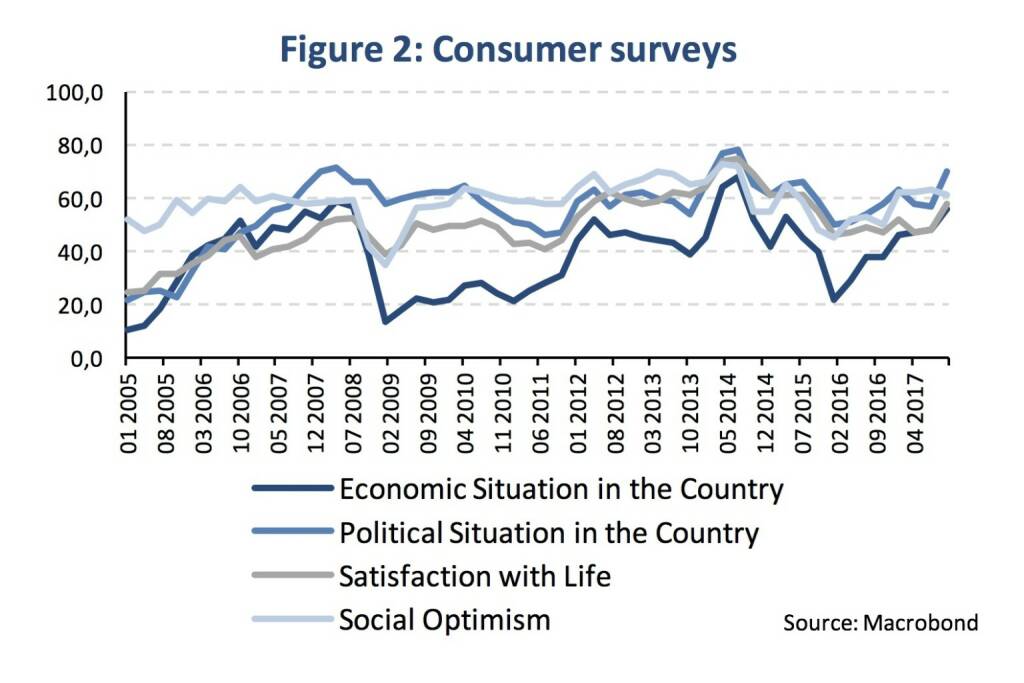
Monthly indicators related to consumers (real incomes and wages, retail sales) and industrial production for December will be released this week. Real wage growth recovered to 5.0 % (y/y) and retail sales rose by 3.0 % (y/y) in November 2017 (3-months average). Reportedly, the government is increasing salaries for civil servants in 2018 (for the first time since 2013) providing support for consumption expenditure. In addition, consumers’ balance sheets gained from the improvement in household lending (+4.9 % y/y in December). Finally, consumer surveys have surged recently (Figure 2).

A jump in the oil price (Brent increased by around 10 % since early December) is associated with higher short-term GDP growth and we have re-calibrated our GDP growth expectation (1.8 % for 2018) accordingly [1]. Additionally, a higher oil price supports the RUB exchange rate. 

    The inflation rate has rapidly been decelerating to a multi-year low (2.5 % y/y in October) helped by a transitory drop in food prices. Against this background, the Central Bank of Russia (CBR) was able to slash the main policy rate to 7.75 % until December (from 10 % in early 2017) to support growth in the economy. Moreover, inflation expectations in the private sector adapted accordingly (Figure 3) and the CBR holds open the prospect of further cuts in the key rate in H1 2018. 

Finally, fiscal policy is set to remain prudent. In November, the 12-months average of the federal budget deficit decreased to 1.8 % after a peak above 3 % in 2016. The new fiscal rule regards any oil & gas income in excess of the one corresponding to a price of oil at 40 USD/bl as unsustainable.  Excess oil income is transferred to the National Wellbeing Fund that amounted to 65.2 bn USD in December 2017 (or around 5 % of GDP). Total foreign exchange reserves were rebuilt to 432 bn USD in December (Figure 4). Central bank reserves had slid in 2015 before the CBR had to abandon the ruble exchange rate band and switched to an inflation-targeting regime. 

Improving household finances, a higher oil price and short-term oil market expectations, anchored inflation, refilled currency reserves and monetary policy room to maneuver as well as a prudent fiscal stance support the Russian economy against a shock from extended US sanctions. 

Authors

Martin Ertl Franz Zobl

Chief Economist Economist

UNIQA Capital Markets GmbH UNIQA Capital Markets GmbH

[1] For example, a 10 % oil increase is associated with 0.3 % higher GDP on impact in Rautava, J. (2013): “Oil Prices, Excess Uncertainty and Trend Growth, A Forecasting Model for Russia’s Economy, Focus on European Economic Integration Q4/13, OeNB


(22.01.2018)

BSN Podcasts
Christian Drastil: Wiener Börse Plausch

Wiener Börse Party #1180: ATX nach umsatzstarken Rekordtagen etwas schwächer, AT&S gesucht, danke an die Porr und Servus TV


Bildnachweis

1. Domestic debt securities

2. Consumer surveys

3. Inflation expectations survey

4. FX Reserves

5. Interest Rates

Aktien auf dem Radar:AT&S, Lenzing, DO&CO, Austriacard Holdings AG, Semperit, EuroTeleSites AG, Erste Group, CPI Europe AG, Verbund, Marinomed Biotech, SBO, voestalpine, Rosgix, EVN, Uniqa, Warimpex, FACC, BTV AG, Zumtobel, BKS Bank Stamm, Amag, Österreichische Post, Telekom Austria, Infineon, IBM, Siemens, Airbus Group, Henkel, Beiersdorf, Symrise, Commerzbank.


Random Partner

cyan AG
Die cyan AG (XETR: CYR) ist ein Anbieter von intelligenten Cybersecurity-Lösungen mit fast 20 Jahren Erfahrung in der IT-Industrie. Die Gesellschaft bietet IT-Sicherheitsprodukte für Endkunden von Mobilfunk- und Festnetzinternetanbietern sowie Finanzdienstleistern an. Die Lösungen werden als White-Label-Produkte in die Apps und Systemlandschaft von internationalen Geschäftspartnern integriert, die diese unter ihrer eigenen Marke den Privat- und Geschäftskunden anbieten. Über Managed Service Provider bietet cyan zudem die Cybersecurity-Lösung cyan Guard 360 für mittelständische Unternehmen an.

>> Besuchen Sie 55 weitere Partner auf boerse-social.com/partner

Consumer surveys


Inflation expectations survey


FX Reserves


Interest Rates


 Latest Blogs

» ATX-Trends: AT&S, Uniqa, Erste Group ...

» Österreich-Depots: Und noch ein High für das gleichgewichtete Austria 30...

» Börsegeschichte 18.6.: Pankl, Strabag (Börse Geschichte) (BörseGeschichte)

» Nachlese: Karl-Heinz Strauss, Klemens Eiter, Thomas Winkler, Sandra Marc...

» PIR-News: Research zu Flughafen Wien, Erste Group, Semperit, Palfinger, ...

» (Christian Drastil)

» ATX leicht unter Rekordniveau: Wiener Börse erlebt umsatzstarke Tage und...

» Porr-Aktie auf Allzeithoch: Kapitalmarktstimmen vom Kundengartenfest in ...

» Wiener Börse Party #1180: ATX nach umsatzstarken Rekordtagen etwas schwä...

» Wiener Börse zu Mittag leichter: AT&S, Flughafen und Bajaj Mobility gesucht


Useletter

Die Useletter "Morning Xpresso" und "Evening Xtrakt" heben sich deutlich von den gängigen Newslettern ab. Beispiele ansehen bzw. kostenfrei anmelden. Wichtige Börse-Infos garantiert.

Newsletter abonnieren

Runplugged

Infos über neue Financial Literacy Audio Files für die Runplugged App
(kostenfrei downloaden über http://runplugged.com/spreadit)

per Newsletter erhalten


Ausgewählte Jobs von PIR-Partnern


Meistgelesen
>> mehr


PIR-Zeichnungsprodukte
Newsflow
>> mehr

Börse Social Club Board
>> mehr
    BSN Vola-Event Infineon
    BSN Vola-Event Siemens Energy
    #gabb #2126

    Featured Partner Video

    SportWoche ÖTV-Spitzentennis Podcast: Punkterekord 2026 dank der Damen, Theme-Song für ATP Challenger Tulln in Vorbereitung (Hörprobe)

    Woche 23 ist nach den French Open und wir haben einen neuen Punkterekord, aber keinen neuen Platzziffer-Rekord. Im gemischten Ranking WTA und ATP sind nun erstmals vier Frauen auf 1-4, dafür ist le...

    Books josefchladek.com

    Antonio Moreno
    Cuaderno de campo
    2025
    Self published

    Pierre Bost
    Photographies Modernes Présentées par Pierre Bost
    1927
    Librairie des arts Décoratifs

    Richard Avedon
    Nothing Personal
    1964
    Atheneum Publishers

    Mellen Burns
    Skimpies
    2024
    burns books

    Dimitri Bogachuk
    Atlantic
    2025
    form.


    22.01.2018, 5088 Zeichen

    CEE: Russia

    •   Threat of further US sanctions downplayed by market participants
    • While the recovery has been weak, several factors support macroeconomic stability.

    In August 2017, US President Trump signed the “Countering America’s Adversaries Through Sanctions Act” that instructed the US Treasury department to prepare reports for submission to congress. With respect to sanctions against the Russian Federation, the treasury was asked to report on potential effects of expanding sanctions to include sovereign debt.  Furthermore, the report is on sanctions against “parastatal entities” and “senior political figures and oligarchs”. The report from the Treasury department is expected by February to be published and submitted to congressional committees. Based on the report, the congress is going to decide on further sanctions. 

    It should be stressed that it is unclear from the current stand point whether sanctions would be extended and to what extent government bonds would be included.   US sanctions on government bonds of the Russian Federation could concern the local bond market denominated in ruble (OFZ) and the international Eurobond market. With respect to the OFZ market, market observers discuss two possibilities: A ban could concern new issuance where only a tiny size of the total market would be hit. On the other side, the inclusion of the total outstanding market is considered as a worst-case scenario with severe implications for the economy. Market participants see a very low probability that the OFZ will be subject to a ban. The domestic debt market has grown strongly (Figure 1) and, in November, around 1/3 of the market was held by non-residents abroad (2.2 trn RUB or 38.6 bn USD) according to the Central Bank of Russia (CBR). Though it seems a more likely scenario, a ban of Russian Eurobonds (securities sold in hard currency in the international bond market) might be rather ineffective. Total Eurobond principal repayments amount to 5.9 bn USD in 2018. The total amount outstanding adds up to 37.3 bn USD. 

    While the recovery of the Russian economy has been weak, a number of factors contribute to increased macroeconomic stability. In Q3 2017, real GDP growth had slowed (1.8 % y/y) compared to the preceding quarter (2.5 %). Economic growth has predominately been driven by the recovery in private consumption (+5.8 % y/y in Q3), while net exports subtracted from GDP growth. Fixed investment is building slowly. 

    Monthly indicators related to consumers (real incomes and wages, retail sales) and industrial production for December will be released this week. Real wage growth recovered to 5.0 % (y/y) and retail sales rose by 3.0 % (y/y) in November 2017 (3-months average). Reportedly, the government is increasing salaries for civil servants in 2018 (for the first time since 2013) providing support for consumption expenditure. In addition, consumers’ balance sheets gained from the improvement in household lending (+4.9 % y/y in December). Finally, consumer surveys have surged recently (Figure 2).

    A jump in the oil price (Brent increased by around 10 % since early December) is associated with higher short-term GDP growth and we have re-calibrated our GDP growth expectation (1.8 % for 2018) accordingly [1]. Additionally, a higher oil price supports the RUB exchange rate. 

        The inflation rate has rapidly been decelerating to a multi-year low (2.5 % y/y in October) helped by a transitory drop in food prices. Against this background, the Central Bank of Russia (CBR) was able to slash the main policy rate to 7.75 % until December (from 10 % in early 2017) to support growth in the economy. Moreover, inflation expectations in the private sector adapted accordingly (Figure 3) and the CBR holds open the prospect of further cuts in the key rate in H1 2018. 

    Finally, fiscal policy is set to remain prudent. In November, the 12-months average of the federal budget deficit decreased to 1.8 % after a peak above 3 % in 2016. The new fiscal rule regards any oil & gas income in excess of the one corresponding to a price of oil at 40 USD/bl as unsustainable.  Excess oil income is transferred to the National Wellbeing Fund that amounted to 65.2 bn USD in December 2017 (or around 5 % of GDP). Total foreign exchange reserves were rebuilt to 432 bn USD in December (Figure 4). Central bank reserves had slid in 2015 before the CBR had to abandon the ruble exchange rate band and switched to an inflation-targeting regime. 

    Improving household finances, a higher oil price and short-term oil market expectations, anchored inflation, refilled currency reserves and monetary policy room to maneuver as well as a prudent fiscal stance support the Russian economy against a shock from extended US sanctions. 

    Authors

    Martin Ertl Franz Zobl

    Chief Economist Economist

    UNIQA Capital Markets GmbH UNIQA Capital Markets GmbH

    [1] For example, a 10 % oil increase is associated with 0.3 % higher GDP on impact in Rautava, J. (2013): “Oil Prices, Excess Uncertainty and Trend Growth, A Forecasting Model for Russia’s Economy, Focus on European Economic Integration Q4/13, OeNB


    (22.01.2018)

    BSN Podcasts
    Christian Drastil: Wiener Börse Plausch

    Wiener Börse Party #1180: ATX nach umsatzstarken Rekordtagen etwas schwächer, AT&S gesucht, danke an die Porr und Servus TV


    Bildnachweis

    1. Domestic debt securities

    2. Consumer surveys

    3. Inflation expectations survey

    4. FX Reserves

    5. Interest Rates

    Aktien auf dem Radar:AT&S, Lenzing, DO&CO, Austriacard Holdings AG, Semperit, EuroTeleSites AG, Erste Group, CPI Europe AG, Verbund, Marinomed Biotech, SBO, voestalpine, Rosgix, EVN, Uniqa, Warimpex, FACC, BTV AG, Zumtobel, BKS Bank Stamm, Amag, Österreichische Post, Telekom Austria, Infineon, IBM, Siemens, Airbus Group, Henkel, Beiersdorf, Symrise, Commerzbank.


    Random Partner

    cyan AG
    Die cyan AG (XETR: CYR) ist ein Anbieter von intelligenten Cybersecurity-Lösungen mit fast 20 Jahren Erfahrung in der IT-Industrie. Die Gesellschaft bietet IT-Sicherheitsprodukte für Endkunden von Mobilfunk- und Festnetzinternetanbietern sowie Finanzdienstleistern an. Die Lösungen werden als White-Label-Produkte in die Apps und Systemlandschaft von internationalen Geschäftspartnern integriert, die diese unter ihrer eigenen Marke den Privat- und Geschäftskunden anbieten. Über Managed Service Provider bietet cyan zudem die Cybersecurity-Lösung cyan Guard 360 für mittelständische Unternehmen an.

    >> Besuchen Sie 55 weitere Partner auf boerse-social.com/partner


    Consumer surveys


    Inflation expectations survey


    FX Reserves


    Interest Rates


     Latest Blogs

    » ATX-Trends: AT&S, Uniqa, Erste Group ...

    » Österreich-Depots: Und noch ein High für das gleichgewichtete Austria 30...

    » Börsegeschichte 18.6.: Pankl, Strabag (Börse Geschichte) (BörseGeschichte)

    » Nachlese: Karl-Heinz Strauss, Klemens Eiter, Thomas Winkler, Sandra Marc...

    » PIR-News: Research zu Flughafen Wien, Erste Group, Semperit, Palfinger, ...

    » (Christian Drastil)

    » ATX leicht unter Rekordniveau: Wiener Börse erlebt umsatzstarke Tage und...

    » Porr-Aktie auf Allzeithoch: Kapitalmarktstimmen vom Kundengartenfest in ...

    » Wiener Börse Party #1180: ATX nach umsatzstarken Rekordtagen etwas schwä...

    » Wiener Börse zu Mittag leichter: AT&S, Flughafen und Bajaj Mobility gesucht


    Useletter

    Die Useletter "Morning Xpresso" und "Evening Xtrakt" heben sich deutlich von den gängigen Newslettern ab. Beispiele ansehen bzw. kostenfrei anmelden. Wichtige Börse-Infos garantiert.

    Newsletter abonnieren

    Runplugged

    Infos über neue Financial Literacy Audio Files für die Runplugged App
    (kostenfrei downloaden über http://runplugged.com/spreadit)

    per Newsletter erhalten


    Ausgewählte Jobs von PIR-Partnern


    Meistgelesen
    >> mehr


    PIR-Zeichnungsprodukte
    Newsflow
    >> mehr

    Börse Social Club Board
    >> mehr
      BSN Vola-Event Infineon
      BSN Vola-Event Siemens Energy
      #gabb #2126

      Featured Partner Video

      SportWoche ÖTV-Spitzentennis Podcast: Punkterekord 2026 dank der Damen, Theme-Song für ATP Challenger Tulln in Vorbereitung (Hörprobe)

      Woche 23 ist nach den French Open und wir haben einen neuen Punkterekord, aber keinen neuen Platzziffer-Rekord. Im gemischten Ranking WTA und ATP sind nun erstmals vier Frauen auf 1-4, dafür ist le...

      Books josefchladek.com

      Richard Avedon
      Nothing Personal
      1964
      Atheneum Publishers

      Antonio Moreno
      Cuaderno de campo
      2025
      Self published

      Joan van der Keuken
      Achter Glas
      1957
      C. de Boer jr.

      Masahisa Fukase
      Sasuke
      2025
      Atelier EXB

      Ola Rindal
      Stains & Ashes
      2025
      Poursuite